Showing posts with label Aldus Roger. Show all posts

Monday, October 4, 2021

Aldus Roger and the Lafayette Playboys- "Marie"


Aldus Roger started playing the accordion at eight years old. His father had a accordion and Aldus would steal it and take it to the barn to play. By the age of twenty one he was good enough that he playing local dances, with Art Freme and Felix Richard. 


While he played the dancehalls at night, during the day he would work as a carpenter. He would make his mark when he formed his band, The Lafayette Playboys, in the late forties.


By the late fifties and early sixties, Aldus Roger was one of the most popular figures in the dancehall scene. Aldus was keen on his band being polished and disciplined. The band was always in demand and was known for their danceable sound. The band reached a new highlight when they had a weekly television show on KLFY in Lafayette.


The Lafayette Playboys recorded for various labels through out their career. In 1953, they recorded for the TNT label. In the mid fifties they recorded several sides for J.D. Miller's Feature label. They would record for Eddie Shuler and Floyd Soileau near the end of the decade.


In 1960, Aldus decided that he had served his time and wished to retire. The retirement would be short lived, for in 1962 Aldus was chosen by Roy Theriot to represent Louisiana at the Folklore Festival in Washington D.C. As a result of this, many friends persuaded him to reorganize his band.


Around 1963 Aldus and his band signed on with La Louisianne Records and recorded with them for the most part of the sixties. By 1968 he returned to recording for Floyd Soileau's Swallow Records. 

The band on this session differs from his previous band; Phillip Alleman is replaced by Isaac Miller on steel guitar. Vernon Bergeron plays drums with Louis Foreman and Tony Thibodeaux on fiddle. Rounding out on bass guitar is believed to be Beaver Leger.


By this time, Floyd had built his studio on East Main Street in Ville Platte when Aldus and his band came in to record a new single. Floyd had a multi story open studio at this time so he had the accordion and singer upstairs and the drummer downstairs.


Floyd recalls:


"..and Aldus was famous for drinking a few more beers than he should, and he was drunk and putting the empty beer can on the drummer and he was ruining the take, and finally I said, "Look, we got several great takes on this song, but while don't we do it one more time, and why don't y'all give me a longer finish on it before we end it." And with that in mind, I was able to fade it out and we were able to capture a very good cut on it. And it was a big record for us in Cajun music."


The record would be a moderate hit for Aldus, one many fans still sing and play.

Moi je peut pas t’oublier bebe
Tu sa-vais que moi j’taimer 
Tu sa-vais que moi j’taimer  catin depuis l’age de quartoze ans

Oh Marie catin garde donc ca t’as fait 
Garde donc t’apres m’quitter apres quitter ton pauvre vieux negre bebe 


Aldus slowly stopped putting out records after the Swallow single. He would go on to release two singles for the Acadian Artists label and then returned in the 1980's, releasing a single for Lanor Records. In a interview with Ann Savoy, Aldus was asked about the future of Cajun music:


"I don't know. But I know what's going on now. They don't play right. Belton Richard can play when he wants to, Milton Adams, the Touchets from Kaplan. I also like Reggie Matte, Nolan Cormier. They still got some that can play when they want to, but to me they still play too much rock and roll and country."


& LAFAYETTE PLAYBOYS


Swallow Studio, Ville Platte LA: 1968

S-45-1021 Be careful, you’re breaking 

my heart Swallow 10196

S-45-1022 Marie Swallow 10196


Resources


Interview with Floyd Soileau

Ann Savoy- Interview with Aldus in Cajun Music Vol 1

notes to La Louisianne 107

Conversation with Michael Dupuy

lyrics- Michael Dupuy

Tuesday, August 11, 2020

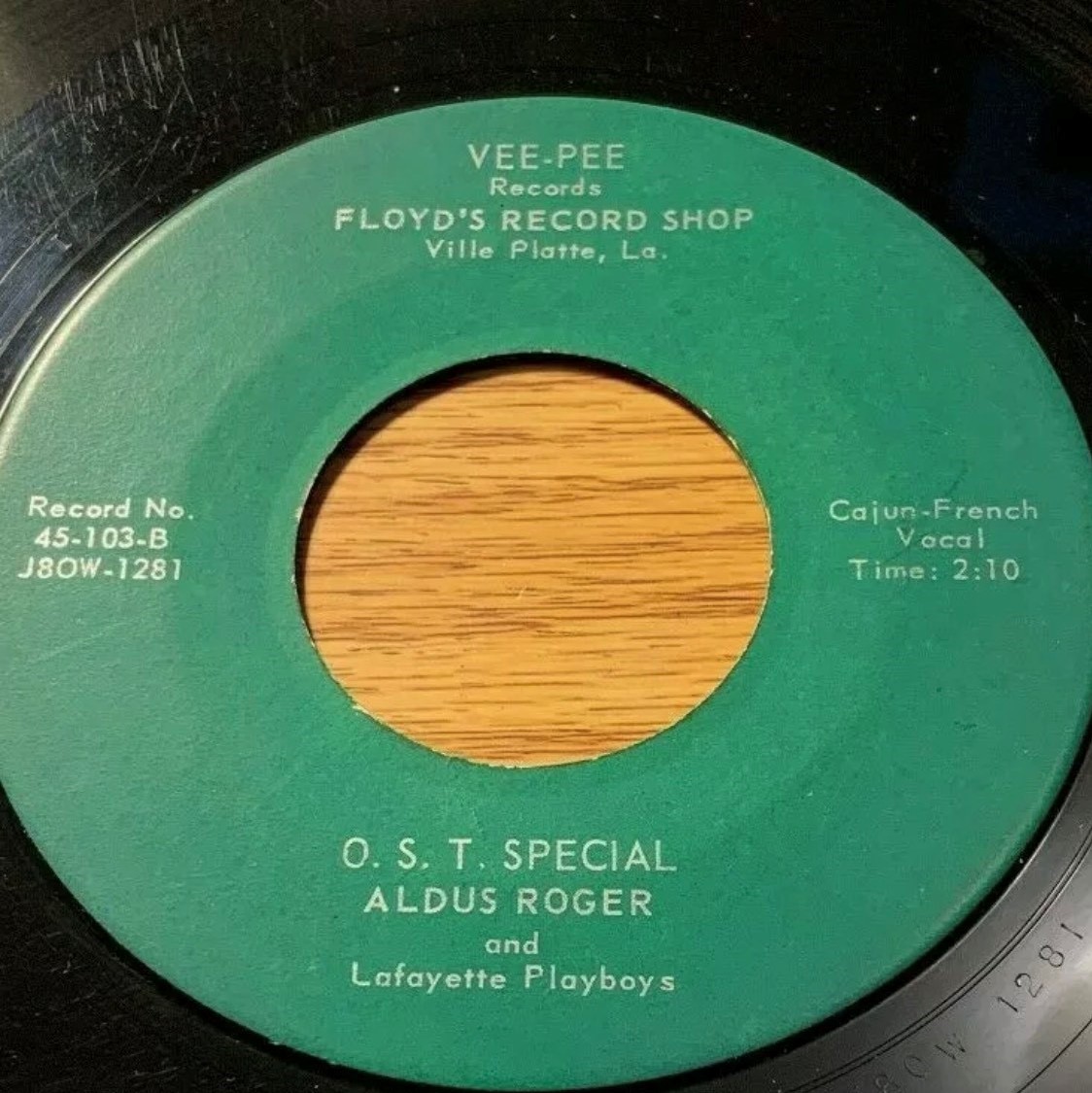
Aldus Roger- O.S.T. Special

                                       
In 1957 Floyd Soileau quit working for the radio station after noticing that Cajun record releases were getting limited. While at the radio station, he had seen ads from Don Pierce of Starday Records advertising to press records. He collaborated with Ed Manuel to put out one record; but after its release, Manuel lost interest. So Floyd decided to go venture out on his own.

He changed the name to Vee-Pee Records after the town of Ville Plate. By this time, Floyd had made some good connections in the record business and the word was out that a new record company had opened up in Ville Platte. He bought 2 songs from Lawrence Walker for 60 dollars and released them on Vee Pee's first release. For that record he only pressed seven hundred 45's and 300 78's. Soon other artists were knocking at the door.


Aldus Roger and the Lafayette Playboys had recorded previously for J.D. Miller's Feature label in the mid fifties. But when labels such as Miller's and Khoury's slowing their Cajun recording down, artists like Aldus were looking for other labels to release their music. Floyd's label was a relief to artist like Aldus as it gave them a renewed output for their music.

Following Lawrence's example, Aldus went to Floyd to record and put out a record of him and his band. While Floyd didn't have a studio yet, he had to use Miller's studio in Crowley for some of his early releases. It was in 1958 that Aldus recorded "O.S.T Special" at Modern Sound Studio for Vee Pee 103. Floyd had it shipped to Nashville and RCA pressed it with a unique green label.

Aldus was known for having a tight band and this recording finds the band playing in high gear. Doc Guidry joined the band during this time and this recording marks his first record with Aldus. Phillip Alleman played his first dance when he was 11 with Aldus; replacing his brother, Clarence, on guitar and started a 25 year career with Aldus. Fernest “Man” Abshire joined the band around this time; he played with Aldus until his death. Johnny Credeur played with Aldus from 1958 to 1964, joining Belton Richard's group afterwards. Tunice "T Man" played with Aldus  for a couple of years, sadly passing away at age 29. 

O.S.T is in reference to the O.S.T dance hall in Rayne, La. The name is shortened for the Old Spanish Trail, named after a colonial Spanish Highway that connected San Diego, Ca. to St Augustine, Fla. The old route is now mostly made up of Highway 90 that passes thru Crowley and Rayne.

Musician Michael Dupuy says about the record:

"The unique and odd thing about that record is the fact that no other instrument takes a lead. It is strictly accordion with a strong rhythm guitar that echoes a bass at times. Also, there’s no drums being played. I am pretty sure it’s a cabasa."


But with this record, Aldus started a long reign in popularity and this was his most productive era. He would continue his career on a popular television show on KLFY for 15 years. He would go on to record for J.D. Miller again but recording for most of the 1960's at La Louisianne Records. As for Floyd, he would soon discontinue the Vee Pee label and would branch off into two labels; Jin and Swallow.


Resources:
Broven: South To Louisiana
Early Cajun Music blog
Michael Dupuy
Johnnie Allen- Memories
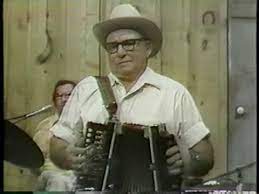
Picture of Aldus from the Michael Dupuy collection.

Session info:
Acdn with possibly Oran ‘Doc Guidry (fdl), Phillip Alleman (st-g), Johnny Credeur
(g), Tunice Abshire (b-g), Fernest ‘Man’ Abshire (v/d)
Modern Sound Studio, Crowley LA: 1958
VP 103A (J8OW1280) Midway waltz
 (La valse a Alida) Vee Pee 103,
Jin 108, Swallow 110
3003, LP6003
Ace(E) CDCHD743
VP 103B (J8OW 1281)O.S.T. (Cajun) special Vee-Pee 103, Jin 108,
Swallow 110, 3003,
LP6001 LP6007,
Ace(E) CDCHD 743

Monday, May 4, 2020

Aldus Roger -"Oson Two Step"


Kate Webster remembered Miller's producing:
"When you go into J.D. Miller's studio you have to cut perfect records. He hears the least mistake, he seems to have microphones in his ears. Yes, he was a good producer."

J.D. Miller started his Cajun Classics label in 1959 starting with a release by Nathan Abshire. The Cajun Classics label offered many Cajun sounds, from the throwback sounds of Moise Robin to the cajun country of Jimmie Choates. Jay Miller was willing to record almost any kind of material as long as it had commercial potential. The more mainstream Cajun performances were popular. Terry Clement's "Les Filles Mexie" and Floyd Leblanc's "Roseland Two Step" were some of the best. Among some of the great recording artists on the Cajun Classics label was Aldus Roger.

Aldus Roger and the Lafayette Playboys set the standard for modern tradional Cajun  bands. He formed the band in the 1940's and always featured the best musicians. Aldus's playing was unlike other accordionists, his playing was loud and full force. He and his band had a devoted following among dancers and musicians.

Aldus was not new to the J.D. Miller studio. He had first recorded for Miller on his Feature label in 1954 and stopped in 1955. When Miller started recording country and blues, Aldus got lost in the shuffle. In 1958 he recorded again for Floyd Soileau's Vee Pee label and again in 1959 for Goldband. In 1960 returned to recording for Miller and his Cajun Classics label. His first release was "Oson Two Step" backed by "Family Waltz". Aldus was always known for having a tight band and this recording is no exception. Doc Guidry plays fiddle on the track with Phillip Alleman on steel guitar, Johnny Credeur on guitar, T-Man Abshire on bass and Fernest Abshire on drums.


The song is similar to Lawrence Walker's "Osson Two Step" which was recorded in 1956 and Pee Wee Broussard's "Creole Stomp" recorded in 1953. As for Aldus, he led his group for over twenty years. He brought Cajun music to a wider audience on his weekly television program on Channel 10 in Lafayette. They had a full hour on Saturdays to play. They weren't paid for the program, instead they used the show to advertise where they were playing that night. He would continue to play and record into the 1980's.


Resources
Early Cajun Music blog
John Broven- South To Louisiana

Sunday, March 1, 2020

Austin Pitre and the Evangeline Playboys- Chinaball Waltz

Austin Pitre was born February 23, 1918 in Ville Platte, Louisiana. Growing up his parents were sharecroppers and would always sing in the field and in the evenings play music on the porch. His father, Joseph, played fiddle, but he presented Austin a accordion on his 6th birthday in hopes of his young son playing with him at fais do do's. By age 11 he was playing with his father as a regular musician.

By the age of 22 he formed the Evangeline Playboys. His flamboyant playing style and energetic vocals set him apart from other musicians at the time. Austin was known for playing the accordion behind his back, over his head and between his legs. 

 In 1950 he had the distinction of being the first Cajun artist to record for J.D. Miller's Feature label out of Crowley. Around this time, Austin had a radio show every Sunday afternoon on KSLO in Opelousas. During the day, he had a steady job as a mechanic. But during the evenings he played locals clubs and dance halls.

His wife, Dorothy recalls,

"Austin was very popular and drew big crowds in a fifty mile radius of our home,
playing six or seven nights a week, plus he worked his day job as a mechanic."

He recorded with Feature records until 1956. At this time labels like Khoury's and Goldband were focused on music outside of Cajun music. Floyd Soileau started recording Cajun music in 1957 with two brief labels; Vee Pee and Big Mamou. Jukebox operator Ed Manuel had recorded Austin and his band at a party and their recording of "Manuel Bar Waltz" would be Floyd Soileau's entry into the music buisness.

It was in 1960 that Austin Pitre and the Evangeline Playboys recorded "Chinaball Blues". The song was actually a melody by Doc Guidry called "Le Nuevo Te Maurice". Austin's "Chinaball Waltz" also sounds similar to his previous Feature recording of "Chatatinia Waltz". 

Austin had a long engagement at the Chinaball Club which was located in Bristol, between Opelousas and Rayne.  The Chinaball Ball Club was originally built in 1949 and owned by Alex Leger. At the time, the Chinaball Club wasn't doing too good. The owner, in a last desperate effort to save his club, begged Austin to play his club. At this time, Austin and his band were drawing capacity crowds wherever they played. The owner told Austin that he didn't come play there that the club would be forced to close up. So Austin and his band packed up and headed to Bristol and brought the crowds with them. A lot of artists around this time recorded songs with the clubs name in it. Sometimes the intent was for more work at the club and sometimes just to celebrate and market the club.


"Viens nous joindre au Chinaball,
c’est pour avoir un bon temps avec votre famille
T’allais voir les mazurkas.
C’est cela, oui qui va vous traiter bien
La plus belle place dedans le pays,
oui, asteur, oui, que tu vas au Chinaball.
Viens nous joindre là-bas au Chinaball.
C’est la place moi je vas quand ça fait noir
Oui, cela ayoù tout le monde
peut se joindre, oui, pour avoir de l’agrément.
Va les joindre ,
Oui, là-bas, la meilleure place dedans le pays."


"Come join us at the Chinaball
to have a good time with your family.
You can see the mazurkas.
It’s the place where they’ll treat you right.
It’s the most beautiful place in the world,
yes, now that you come to the Chinaball.
Come join us out there at the Chinaball.
It’s the place that I go when it’s dark out.
Yes, the one where everybody
can meet up, yes, to have fun.
Go join them,
Yes, out there, the best place in the world."

n 1959 Soileau had changed the name of his label to Swallow and would continue to record and release Austin's music. His recording of "Flumes Dans Faire (Flames of Hell) was the first big hit for the label. He recorded for the label from the late 50's until the 1970's. In 1973 Austin was invited to perform in Washington, D.C. to perform at the Smithsonian Festival. He passed away April 8, 1981.


Resources
John Broven- South to Louisiana
Early Cajun Music Blog
lyrics by Erin S.

Thursday, February 20, 2020

Aldus Roger and The Lafayette Playboys- New Mardi Gras Dance


During Mardi Gras in the rural areas of south Louisiana, communities will dance around to the playing of a Cajun accordion, known as the Mardi Gras dance.


Aldus Roger was born in Carencro in 1915. Growing up his father didn't want him playing the accordion. But Aldus would borrow one and sneak out to the barn and play. By his mid-teens he was playing in public. During the 1940's he formed his group, The Lafayette Playboys. Aldus began to make his mark with his band in the 1950's during the accordion revival.

Aldus looked to Lawrence Walker as a inspiration growning up. He remembers watching Lawrence play and imitating his style. In the Lafayette Playboys, he surrounded himself with professional musicians who were well rehearsed. By the 1950's television stations in south Louisiana provided a few shows aimed at local audiences. By June 1955, KLFY offered viewers a half hour Cajun music program of Aldus and his band.


Aldus and his band were recording for J.D. Miller's Feature label at this time. From the late 50's to the 1960's he recorded for Feature, Swallow and Goldband. In 1960 he returned to recording for Miller on his Cajun Classics label. It was here he recorded another version of his Feature Classic, "Mardi Gras Dance". Miller had previously recorded great Cajun Music on his Fais Do Do and Feature label. Around 1955 he had focused on mainly country and blues. With the recent success of Floyd Soileau's Swallow label, Miller started recording Cajun music again on his new 45 labels.

In 1960 he recorded "New Mardi Gras Dance" for Miller's Cajun Classics. The song is a quick tempo, full sounding instrumental with solos throughout the song. Unlike the early traditional chant, the "dance" would have a bluesy chord progression with room for different musicians to take the lead. Aldus's version of the deeply traditional Mardi Gras Dance took it a step further,being pepped up to a frenzy by rock and roll drumming.

It was recorded in Crowley, Louisiana in 1960 at Miller's Modern Sound Studio. Joining in on this version, it featured the great fiddle work of Doc Guidry. Rounding out the band were Phillip Alleman, Johnny Credeur,Tunice Abshire and Fernest Abshire.

Throughout the 1960's he continued performing on KLFY and recording for La Louisianne. His last released record was for Lanor in 1981.


Resources
Early Cajun Music blog
Lyle Ferbrache- Accadian All Star Special