On December 9, 1929, Amede Ardoin and his partner, Dennis McGee, recorded their first recordings in New Orleans. The very first song they recorded was a number called "Taunt Aline". Ardoin's popularity took off after their first recordings and the music influenced generations to come. One of those influenced was a young boy named Iry LeJeune.
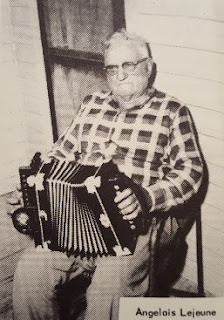
Iry grew up fascinated with the music he heard around him. His great uncle, Angelas Lejeune, was one of the top accordion players in the area. Like McGee and Ardoin, Angelas had recorded in the 1920's as well, recording for the Brunswick label. At the sessions, Angelas would record "La Valse de Church Point" and the first recording of "Perrodin Two Step". Playing with him on the sessions were Dennis McGee and a Church Point fiddler named Ernest Fruge.
Iry would visit Angelas who lived just a mile away and it was there Iry learned how to play the accordion. Angelas also introduced the young Iry to the sounds of other accordion players. At his home, Angelas had a phonograph player and played Iry 78's of other players such as Amede Ardoin, Joe Falcon and Amade Breaux. Iry would sit and listen and study these records, retaining every note in his head. Surely it was there that Iry first heard Ardoin and McGee playing "Taunt Aline".
By 1954, Iry had recorded and released several records. The band kept busy with playing clubs across the area as well. They would play the Blue Goose in Eunice and at the Shamrock Club. Milton Vanicor recalls Nathan Abshire stopping by the Shamrock and playing with Iry and the band one night. Iry would also play at the Red Barn Club in Texas and the China Ball Club in Bristol. Luderin Darbone recalls Iry stopping by the Silver Star to listen to the Hackberry Ramblers from time to time.
In 1952, Eddie had recorded Iry at his home on his reel to reel recorder. He returned in early 1954 to record another session for upcoming releases. The recordings were made over several dates and included Iry, Wilson Granger and Alfred Cormier. For one of the songs they recorded, Iry drew inspiration from Ardoin's "Taunt Aline" and used it for his song, "Come and Get Me".
Oh ye yaille, chere tit monde, catin,
Mets-toi voir bien jongler
Ca t'as fait.
C'est pas la peine
Que tu le lamentes.
Viens donc me chercher, ye yaille.
Ton papa va venir.
Je peux pas aller t'apres.
Oh, tite fille, c'est tous les soirs,
Je me couche.
J'embrasse mon oreiller
Des fois en jonglant,
Faire des accroires que ca serait toi
Qui serais la, ye yaille.
Mais, tout je peux voir,
Tu t'en reviendras pas
Me revoir.
Iry's version of the song tells about a young man lamenting that his "catin" won't come back since her father brought her back home. He sings of the young man kissing his pillow and believing in is her beside him. The song was also known as "Viens Me Chercher".
Iry's 1954 recordings would be his last for Eddie Shuler. His recordings for opened the doors for many other artists to record. Eddie was known to often say that Iry never made a record that wasn't a hit and by the mid 1970's, Iry Lejeune's records were still the most popular of the Goldband artists. As for the melody of "Taunt Aline" and "Come and Get Me", it would go on to be used by The Balfa Brothers for their 1974 recording "J'Sus Orphelin".
Resources
Ron Yule- Wailin The Blues Cajun Style
Wade Falcon- Early Cajun Music blog
Session info
V/acdn, Wilson Granger (fdl), Alfred Cormier or Eddie Shuler (g)
By 1954, Iry LeJeune was no stranger to recording. His fascination with commercial recordings stimulated his desire to record. Unable to work on the family farm due to his poor vision, Iry spent time playing devoloping his style by playing along with his 78 rpm records on his phonograph.
A good example of Iry's connection to commercial recorded music is "Love Bridge Waltz". Iry used the melody of a 1929 recording from Delin Guillory and Lewis Lafleur song called "Alone at Home" for his song. While the Guillory and Lafleur song was recorded in 1929, it wouldn't be until 1940 until it was released. The delay of this record release; in conjunction with the Lee Sonnier's Acadian All Stars post war releases, sparked the accordion revival that thrived in Cajun Country following World War II. Iry first recorded with the Oklahoma Tornadoes, after Sonnier's Acadian All Stars groundbreaking collaboration with Happy Fats. Afterwards, Iry was constantly asking Eddie Shuler to record him. Iry recorded again with two sessions at KPLC in Lake Charles. After these sessions, Eddie Shuler bought a reel to reel recorder and began recording Iry at his house. Eddie explains: "I bought a tape recorder, and it cost $237, which was a lot of money in those days. We would put the machine on the kitchen table and cut these things..." It was at the 2nd session at Iry's house that he recorded "Duraldo Waltz". The song was brought to the session by fiddler Wilson Granger. He had the song in his head from hearing his father play it around the house. Wilson whistled the tune to Iry and he made up some lyrics on the spot. Duralde is a small community outside of Eunice where Iry often played at. There were two recordings of the song released, with two slightly different lyrics. But on the song Iry put down the accordion and let Wilson's fiddle playing shine. Iry often would call out to Wilson on the recordings; saying "Eh Pill" for Wilson's solo. Iry would call him this because Wilson had severe headaches was constantly taking Aspirin.
The song was recorded at Iry's home in the kitchen with the reel to reel on the kitchen table. Those present at the session were Iry, Wilson Granger and Alfred Cormier. Iry had a family dog named Rain, that was there at the session as well. During the recording, someone came to the door and Rain barked at them. On this version of the recording, Rain's bark was left on the recording; the other version Shuler released had different lyrics and was missing Rain's bark. Over time people would approach Shuler and ask him about the dog on the recording. It seems odd to why Shuler would release two different versions. Eddie was also known to turn on the recorder and record the band while they warming up. He would release these recordings as well as recordings he spliced together. This record continues in Eddie's tradition of assuming song writing credits for songs he clearly did not write. Iry would continue playing and recording until his death. He got tired of Eddie's antics and bought himself a recorder to record and release his material. By mid 1955 he was playing around Lake Charles when Wilson quit him to pursue other interests. Iry turned to his old friend, J.B. Fuselier to help him out on the fiddle. One night they were coming from a dance in Eunice and the car had a flat. A incoming car struck them and killed Iry and seriously injuring J.B.
Resources
Ron Brown- Iry Lejeune:Wailing the Blues Cajun Style
Early Cajun Music Blog
Ryan Brasseaux- Cajun Breakdown
Vorris "Shorty" Leblanc was born in Jefferson Davis Parish on Christmas Eve of 1923. At a early age he took notice of Cajun music being played around him. He soon became accomplished on numerous instruments and taught himself music without reading or writing the music. His nickname came about from the fact that his brothers were over 6 feet tall and he was under that height. He bought his first accordion, a Sterling, while stationed in Europe during WWII and brought it home with him. During the late 1940's he played with Iry Lejeune and others throughout the area and in 1951, when the Laccassine Playboys split; Shorty replaced Iry on accordion. In 1955 they disbanded and Shorty played with other musicians in the area including Alfred Cormier, Jay Stutes and Charlie Babineaux. In the late 1950's, he joined Cleveland Crochet's Hillbilly Ramblers, playing a brand of Cajun music blended with some country and pop tunes. In 1960 the group recorded "Sugar Bee" which broke into Billboard's top 100. Following the hit, the group was renamed the Sugar Bees and began to play many bookings in the area. The group was so popular that a West German film company came to Lake Charles in 1963 and made a 30 minute film featuring the band. As a follow up to the hit, the group recorded many sides on the Goldband label in the next couple of years. Included in these recordings was "Boss Cajun".
"Boss Cajun" was recorded in 1961 at Goldband Studios. The band was essentially the Sugar Bees on the recording. Shorty played accordion with Cleveland on fiddle, Jay Stutes on steel guitar, Charlie Babineaux on guitar, Bradley Stutes on bass and Clifton Newman on drums. It features Shorty's great accordion work and rocking guitar work from Charlie Babineaux. The song is similar to Nathan Abshire's "Lake Charles Two Step" recorded in 1950. Shorty's "Boss Cajun" is still played by many groups today. By 1963, Shorty left the Sugar Bees and formed his own group. They later became the Acadian Aces with Cliff Newman on drums, Benny Martin on guitar, and Jay Stutes on fiddle. Shorty also recorded with Jimmy C. Newman on his album, Folksongs of the Bayou.
Resources
Ron Yule- Cajun Dancehall Heyday
with thanks to Winnona Landry for information about her father.
Johnnie Allan- Memories Volume One
Micheal Dupuy
Iry Joseph Lejeune was born October 27, 1928 into a musical family of country farmers. At a early age, it was noticed that Iry had impaired vision that seemed to follow the Lejeune family. At a early age he began playing the harmonica. Then at age 6 he began playing the accordion. He began playing on his father's accordion even though his father was worried he would break it. Iry went wherever he could to hear and learn accordion. He learned most of the time from his father and his great uncle, Angelas Lejeune. On a trip to New Orleans during 1946, Iry began he began playing in a bar where he received $50 dollars a night plus tips. Floyd Leblanc's group, The Oklahoma Tornadoes, were playing next door. Iry met up with Floyd and was soon playing with his group. Bennie Hess played guitar in the group and was in the process of starting a record label in Houston. Iry's first record was on the label of Hess's. After the recording, Iry kept busy playing around the house. After Iry's first recordings, his music begain to take off. Iry met Eddie Shuler at the time when Eddie's band had a show on KPLC. He wanted Eddie to put out his records out and the pair worked out a deal and soon Shuler was putting out Iry's records. He was even recording Iry at his home. Eddie recalls: "I bought a tape recorder, and it cost $237, which was alot of money. We went to Iry's house when we first started, and he lived in a old house out there in Lacassine. We'd put the machine on the kitchen table and cut these things..." The first session at Iry's home in Ardoin Cove was recorded on Shuler's reel to reel recorder. Playing with Iry on the session was Milton Vanicor on fiddle and Eddie Shuler on guitar. The first sessions were recorded in one night and was believed to be recorded in November 1952. "Church Point Breakdown" was a ode to the town of Church Point, not far from where Iry grew up. Iry converted Angelas Lejeune's "Le Petite One Step" into his own the number. Its one of the few Iry releases that Eddie pressed only on 45rpm. "Eh ye yaille, malheureuse! Tous les jours dans ma maison, J'apres mais t'esperer. Eh, rappelle-toi, catin, Ton papa et ta maman t'a toujours dit De pas faire ca avec ton negre. Eh ye yaille, tous les jours Apres souffert dans ma maison Plus personne qui vient me rejoindre. Tite fille, tous les jours tu connais Pour venir puis voir Quo faire que, moi, j'suis la'. Eh, bebe, tous les jours Moi j'suis la sus ma galerie Apres esperer pour ton vieux negre. Oh, tu devrais jamais m'oublier 'Tant loin q'moi j'm'en vas te dire Donc garde donc j'm'ennuie de toi"
Shuler continued recording Iry and releasing his records. Iry was known to never limit himself to traditional sounds. Luderin Darbone recalls that Iry came by the Silver Star to the listen to the Hackberry Ramblers from time to time. In the summer of 1955, Iry began to team up with his old pal, J.B. Fuselier, who had moved to Lake Charles. They were finishing a Friday night dance at the Green Wing Club in Eunice, and was returning to Lacassine when hey had to stop and fix a flat tire. They were hit by a speeding car and J.B was injured, Iry was killed instantly.
Sidney Brown was born October 28, 1906 in Church Point. Growing up, he was self taught on the accordion. He would borrow a accordion and sit in the field and play. By the time he was 13, he was already playing house dances and fais do-dos. After years of working in the oilfield as a roughneck, he moved to Lake Charles from Ville Platte in 1940. There he found work as a woodworker and carpenter. It was here that Sidney began developing his skills towards making and repairing accordions. He would eventually be recognized as the first person to build Cajun accordions after WWII in Louisiana. After World War II he formed the Traveler Playboys. In 1948 they played on KPLC on a weekly 30 minute broadcast. From 1952 to 1959, Sidney performed with the Musical 4 + 1 and the Hillbilly Ramblers, as well as his own bookings. In 1955, Sidney and his band began recording for Eddie Shuler. Eddie had been inspired by the success of Iry Lejeune's records and became more involved in recording Cajun music. Sidney's record "Pestauche A Tante Nana" would become the third best selling record in the history of Cajun Music. Sidney and his band played many clubs in Louisiana and Texas. They also appeared on KPLC radio with the Israel Lafleur Show and on KPAC television in Port Arthur. "La Misere de Mon Beau-Pere" ( My Father-In-Law's Sorrow) was recorded in 1958 at Goldband studio in Lake Charles. Playing with Sidney on the recording was Nelson Young on fiddle, Cliff Newman on vocals, John Crochet on drums and either Tilford McClelland or Mervin Faul on steel guitar. Toi, petite fille, qu'est assis la galerie, le chapelet dans la main, après prier pour tout qui vient jolie fille, pourquoi donc t'es comme ça, tu connais pour toi même quand ça fait du mal. toi, malheureuse, pas la faute à ton beau père, pas la faute à la petite mère.
toi, petite fille, rappelles toi pour toi même les misères tu m'as fait .... In the early 1960's Atlas Fruge joined the Traveler Playboys on steel guitar. By this time Sidney's health began to fail and he slowed down, eventually quitting any dancehall performances. He continued to perform on a limited basis, even winning the Cajun Days accordion contest in 1968. He continued building and repairing accordions, producing a unknown amount, many which are still in use today.
Sidney's impact on the local accordion scene is noted by Mervin Faul. Mervin played steel guitar with the Veteran Playboys for a while in the 1950's when Shirley Bergeron quit because his father's accordion was so bad out of tune and Shirley couldn't stand the sound. The other band members talked Mervin into talking to Alphe about it. Alphe let Mervin take his accordion to Sidney to repair. After his accordion was fixed the band continued playing. But Shirley would peek in and listen in to the group. It wasn't long before Shirley was back in the band thanks to Sidney's repair's to his fathers accordion. In the early 1960's Atlas Fruge joined the Traveler Playboys on steel guitar. But by this time Sidney's health began to fail and he slowed down, eventually quitting any dancehall performances. He continued to perform on a limited basis winning the Cajun Days accordion contest in 1968. He continued building and repairing accordions, producing a unknown amount, many which are still in use today. One of Sidney's accordions sits in the Acadian Memorial in St. Martinville, Louisiana. He passed away on August 6, 1981.
Resources-
Early Cajun Music Blog
Accadian All Star Special
Ron Yule-Cajun Dancehall Heyday
lyrics by Stephane F.
A artist that recorded for Goldband Records was listed as "Iry Le June Jr.". To some this name draws puzzled looks and questions. Who was Iry Le June Jr.? This artist recorded 2 records for Goldband and Jador. But the idenity of the artist is none other than Ervin J. Lejeune, Iry's oldest child, who was not named for his famous father.
Ervin began playing at house dances around the age of nine or ten. He played his father's accordion around the house but his mother Wilma, keep it guarded. In 1963, Ervin played at a tribute to Iry at the Sparkle Paradise in Bridge City. By 1966, Ervin moved to Sulphur for work and began playing with musicians in the area. He was underage at the time and club owners would let him sneak in and play.
Ervin had been playing with Jake and Robert Bertrand at clubs in the late 1960's. After some time, Ervin joined the Louisiana Ramblers. Robert wanted to record and talked Ervin into recording, even though he was leery of Eddie Shuler and his buisness practices. This uneasiness came from Iry's unfavorable dealings with Eddie and Goldband. Ervin wanted to step out on his own playing music as a solo act.
In the early 1970's, Ervin set up a recording session at Goldband like his father before him, with the recordings being produced by Eddie Shuler. "Lawtell Two Step" and "Love Bridge Waltz" was recorded with Robert Betrand on fiddle. When Ervin went to the studio to pick up some records to sell, he discovered Eddie had used the Iry Le June Jr tag and a argument ensued. Eddie had used this as a tactic to sell more records and Ervin, who was trying to establish his own musical identity wasn't happy. This conflict between Ervin and Eddie over mislabeling would happen once more before Ervin had had enough.
Joining Ervin on the session was Robert Bertrand on fiddle, Ronnie Anderson on drums, and T-June Benoit on guitar. Reflecting on the session and dealing with Shuler, Ervin stated: "Iry had already been down that path before and I decided not to go there." Ervin continued playing at festivals throughout Louisiana and Texas. He recorded with the Calcasieu Cajuns, Louisiana Ramblers, and the Sundown Playboys. Along the way he also took up accordion building. He passed away on January 26, 2018.
Resources Ron Yule-Iry Lejeune- Wailin'The Blues Cajun Style