Showing posts with label George Khoury. Show all posts

Thursday, April 1, 2021

Lawrence Walker- "Evangeline Waltz"


George Khoury was a business man from Lake Charles who owned a record shop. He got into releasing records by financing Virgil Bozeman's OT Records. Soon he started his own record label, calling it Khoury's. Operating out of his record shop, he soon was attracting Cajun musicians from East Texas and south Louisiana.


With his new business, he started off with the recordings of Lawrence Walker. Lawrence's popularity was well known around south Louisiana at this time as he was filling up the local dancehalls. Khoury signed Lawrence before Nathan Abshire as he knew Lawrence's intense accordion would rival Nathans's.


So in 1950, Lawrence emerged from retirement and stated recording for George Khoury. That first session produced two records. They sold well enough and the following year; Khoury had him back in the studio. Lawrence did something different than what his competitor Nathan was doing; he added a hypnotic drum beat to his songs. This session produced what would be his biggest seller; "Evangeline Waltz".


J'sus assis dans la port de ma maison, après pleurer,


J'sus après pleurer pour tu t'en reviens à rejoindre ton nègre,

Oui, chère 'tit monde, quand t'as quitter d'la maison,

Tu m'as dit tu pouvais, mais, p'us m'aimer,

Oh, yé yaille, mon cœur me fais mal.  

J'ai p'us personne à la maison, mais, pour m'aimer.


Oui, chère 'tit monde, si tu voudrais t'en revenir,

J'te pardonnerais pour tout ça que tu m'as fait,

C'est d'voir, aujourd'hui, j'ai p'us personne pour m'aimer

J'sus moi, tout seul, après mourir dedans l'chagrin.

Oh, bébé, mon chère 'tit bébé,

J'ai p'us personne à la maison, mais, pour m'aimer.


J'sus assis dans la porte de ma maison, après jongler,

J'sus après jongler si jamais tu va revenir,

Oui, chère 'tit monde, quand t'as quitter d'la maison,

Tu m'as dit tu pouvais, mais, p'us m'aimer.


Lawrence and his band play top notch here, doing a bluesy waltz. His band at the time consisted of U.J. Meaux on fiddle, Demus Comeaux on guitar, Junior Benoit on steel and Lawrence Trehan on drums.


While most pressings started off with a run of 500 copies, its safe to say "Evangeline Waltz" had multiple pressings.  Even when Khoury started focusing on rock and roll and country sides later on, he would reissue his big sellers on the new 45 rpm medium. The only two Cajun artists he reissued on 45 rpm was Nathan Abshire and of course; Lawrence Walker.
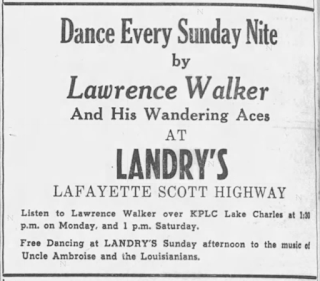

Lawrence's sound became the prototype of what Khoury's records were to sound like.  His success on Khoury's  prompted George Khoury to sign Nathan in 1951 and even had him to stick with the formula that Lawrence had created. He would go on to record for the label until 1955. Even then Lawrence would try to keep up with the times, even recording up tempo English songs.


Years later when Chris Strachwitz was compiling a Khoury's recording compilation, George Khoury was insistent on having Lawrence's "Evangeline Waltz" on it saying:


"Make this at once- will pay you for your trouble. Don't let no one have Evangeline Waltz!"


Session info

V/acdn, Ulysse Joseph (U J) Meaux (fdl), Demus Comeaux (g).Valmont ‘Junior’ 

Benoit (st-g), Lawrence Trahan (d)

Lake Charles LA; (possibly Goldband Studio) 1951

A Evangeline waltz Lyric/Khoury’s 615


Resources

Wade Falcon- Early Cajun Music Blog

Liner notes to Cajun Honky Tonk Vol 1 & 2

Monday, January 4, 2021

Blackie and the Moonlight Serenaders- "La Robe Barre"


George Khoury created the Khoury's label in 1950. He recorded such greats as Nathan Abshire, Lawrence Walker and Dewey Balfa on the label's 600 series. The label had success with these and other artists until the late 1950's.


By the time George Khoury started  his 700 series, he had little or no interest in Cajun music. The  series started off with Nathan Abshire and included Cleveland Crochet. But then songs like Cookie and the Cupcakes "Mathilda" hit, leaving George interested in other genre's.


In 1959, Khoury had a even bigger hit with Phil Phillips's "Sea Of Love". He would only release two Cajun records that year, one being by Pee Wee Broussard and the other being by Lawrence "Blackie" Fruge.


Blackie grew up on a very musical family. His father, Lawrence Fruge played the fiddle and accordion as well. He formed a family band, The Tee Mamou Playboys, in 1950. Blackie moved to Lake Arthur in the 1950's where he worked as a paint and body man while playing music on the side.


 In 1959 he and the Moonlight Serenader's recorded "La Robe Barre" at the KJEF radio station in Jennings. The song was a cover of a J.B. Fuselier song recorded in 1938.


Blackie's uncle, Ernest Fruge, had played in the 1920's with Dennis McGee; who had originally recorded the song with Amede Ardoin as "Madame Atchen". It was later covered by Leo Soileau as "Embrace Moi Encore". Leo's version could have possible influenced J.B. Fuselier's version he recorded as "La Robe Barre" in 1938.


Joining Blackie on the recordings was his brother Joseph on guitar, his sister Eula Mae Fruge on bass, Voylen "T-Boy" Esthay on fiddle, Mayeuse Manuel on accordion and Lewis Scott on steel guitar. The KJEF studio in Jennings was also used by Tan Benoit to record a session for Hot Rod Records.


Blackie would go on to record with Milford Simon on the Cajun Jamboree label in the late 1960's. In the 1970's, he recorded for C.E. Diehl's Circle D label in Jennings.


Session Info:


BLACKIE & THE MOONLIGHT SERENADERS (725)

Lawrence ‘Blackie’ Fruge (v-1/g), J U Fruge (v/g), Voylen ‘T-Boy’ Esthay (fdl),

Mayeuse Manuel (acdn), Eula Mae Fruge (b), Lewis Scott (st-g)

KJEF Radio Station, Jennings LA: 1959

KH 553 La robe barre-1 Khoury’s 725


Resources:


http://www.bopping.org/the-khourys-label-cajun-concern/

Early Cajun Music blog

Conversations with Micheal Fruge

Ron Yule- Cajun Dance Hall Heyday

Sunday, June 28, 2020

Lawrence "Blackie" Fruge- Elton Two Step

Lawrence "Blackie" Fruge was born September 20, 1930 and grew up in a musical family. His uncle was Ernest Fruge who recorded for Brunswick records in 1929 and 1930. His father, Lawrence Sr, taught children how to play various instruments when they were growing up. Blackie started playing when he was 12 years old starting with the fiddle, then learning the drums and guitar.

Around 1950 he played in his father's band, The Country Playboys, which included his brothers and sister. They recorded one record on the TNT label. In the mid 1950's Blackie built a home in Jennings and a year later it was destroyed by Hurricane Audrey. He built a home in Midland, then moved to Lake Arthur where he worked as a paint and body man and played music. In 1959 Blackie recorded one record; one of the last Cajun records to be released on Khoury's records.

For George Khoury, Cajun releases on his label after 1955 were slim. With a couple releases by Nathan Abshire and Pee Wee  Broussard, he had other interests in mind. He had a hit on his hands with Cookie and the Cupcakes R&B hit "Mathilda" and he was looking into that field more than ever. In 1959, he landed a even bigger hit with Phil Phillips' "Sea of Love". And in that year he only released two Cajun releases, one being by Blackie and the Moonlight Serenaders.


Blackie and the Moonlight Serenader's "Elton Two Step" was recorded in KJEF studios in Jennings. The song bears no resembleance to JB Fuselier's version nor Amede Ardoin's. It is a rousing version of "Creole Stomp" previously recorded by Pee Wee Broussard 
and Lawrence Walker. Joining Blackie on the recordings was his brother Joseph on guitar, his sister Eula Mae Fruge on bass, Voylen "T-Boy" Esthay on fiddle, Mayeuse Manuel on accordion and Lewis Scott on steel guitar. 


Later in 1967, he would go on to  recorded for the Cajun Jamboree and Circle D labels. He also recorded with the Tee Mamou Playboys, Louisiana Rhythmaires,Crowley Playboys, Cajun Kings, Lake Charles Playboys as well as his own group, The Hicks Wagon Wheel Ramblers. He also was known to play with Ally Young and the 7-Up Playboys. Blackie can also be found singing on Lionel Cormier and the Sundown Playboy's "Black Bayou Special".


Resources
Early Cajun Music Blog
conversation with Micheal Fruge
Ron Yule- Cajun Dance Hall Heyday

Monday, March 30, 2020

Nathan Abshire- Hoola Hoop Two Step

The end of the 1950's left Cajun musicians in a comprising situation. The years before found south Louisiana independent labels like Khoury's, Feature and Goldband finding success with their Cajun recordings. But by the end of the decade these labels were finding success in other genres.

J.D. Miller was one of those. By the mid fifties he was recording not only Cajun French but was recording more blues and swamp pop sessions. He was recording blues for Excello, rock and roll and R&B for his Rocko and Zynn labels.

Miller's interest in recording Cajun music again might have been sparked by the success that Floyd Soileau was having with Swallow records. At any rate, Miller started recording Cajun music again in 1959. And with the entrance back he grabbed one of the biggest recording artists for his new label. 

Nathan Abshire had recorded for Khoury's from the late 40's to the 50's. His last recordings for Khoury were in 1959, with "Cannonball Special" and "Red Rock Waltz". George Khoury was finding success with blues, R&B and swamp pop as well. His Cajun recording had slowed down to a trickle with some of his last Cajun recordings done by Pee Wee Broussard in 1959. But as far as Nathan, he was far from done.

After a uneventful decade since the success of "Pine Grove Blues" in 1949, Nathan saw his fortunes improve when he recorded for Miller during the early sixties. He had a modern Cajun band lineup augmenting his stunning accordion work. He went on to have a fine series of releases for the Crowley record man, whose production skills were as good as ever. On these recordings he brought the blues and honky tonk and released some of his more rock and roll output.


Miller started Cajun Classics with Nathan releasing the first sides on the label. He brought along a familiar friend in Dewey Balfa to these recordings. On Cajun Classics 101 he recorded "Hoola Hoop Two Step." Nathan was a big fan of The Segura Brothers. On Khoury's, he had reworked their song "A Mosquito Ate My Sweetheart" into "La Valse De Holly Beach". He did the same with his first recording on Cajun Classics. He reworked the Segura's "Rosalia" into "Hoola Hoop Two Step". The Segura's "Rosalia" itself was derived from Amede Ardoin's "Les Blues De Voyage". Nathan always seemed to have a way into reworking old classics and making them relevant.


Miller recorded some of Nathan's best material in the 1960's. He proved that he was still a driving force in Cajun Music. In his Miller recordings he brought back "Pine Grove Blues" with a new updated version. He reworked some old classics and introduced some new songs as well. But by 1965 he had left Miller and signed with Floyd Soileau's Swallow records. His Miller recordings seems to be overlooked for some reason, as his Swallow recordings are more well known. But the Miller years for Nathan are a definite high point in his career.
                             

Resources
Early Cajun Music Blog
John Broven-South To Louisiana
Thanks to Wade Falcon

Saturday, February 8, 2020

Lawrence Walker and His Wandering Aces- Reno Walz (La Valse De Reno)


Lawrence Walker was born September 1, 1907 in Duson, La. At age 13 he began playing in a band with his father and brother. He and his brother first recorded with Brunswick in 1929 and then again in 1935 with Bluebird Records.

He returned to farming after the Bluebird recordings and later on, back to recording and playing after World War II. Lawrence and his Wandering Aces played the clubs and had a string of recordings from 1950-1962. By the 1950's Lawrence was known for developing a new style in Cajun music. He was known to be a perfectionist; he demanded higher standards of his band.

He first recorded "Reno Waltz" for George Khoury's label. Reno was named after the Reno Dance Hall located between the towns of Kaplan and Gueydan. It is based on a older tune, "La Valse de Grand Chenier". Lawrence had gotten into a argument with Reno's owner, "Dado" Seaux. In order to make amends and to keep performing there, he named the song after the Club. Lawrence's popularity in his live performances earned him the title "King of The Dancehalls". He was a big leader in the accordion revival in Cajun music. Johnnie Allan remembers:

            " Lawrence was a big factor in French music. His songs were all the sad, melodic type songs, he was a very good  accordion player, very well known in the area. I played steel guitar for him for 6 years and he crowds were tremendous almost everywhere we played."

From 1950 thru 1955 Lawrence and his Wondering Aces recorded for Khoury's. By the late 1950's, Khoury lost interest in recording Cajun music, Lawrence aproached Floyd Soileau to release his recordings. Two records were released on Swallow in 1956 and Lawrence didn't have a record come out until 1961. 

Carol Rachou built a studio in Lafayette out of his parent's old grocery store and started his label, La Louisianne. From 1961 thru 1962, Lawrence released seven titles on La Louisianne Records. Along with one of the first Cajun rock and roll numbers sung in English; "Allons Rock and Roll", he also recut his Khoury classic, "Reno Waltz". On this version, Lawrence used different lyrics than he used on the original and replaced the steel guitar with fiddling by "Doc" Guidry.

Oui, la place que moi, je voudrais mourir                      
c’est dans les bras de mon petit bébé.                          
Demander pardon pour ça j’ai fait,                             
là je serais d’accord de m’en aller dans Grand Gueydan.         

Quand je vas mourir, j’aimerais que tu viennes.                 
Fermer mes yeux, petit bébé, pour moi je m’en vas.              
Pour moi, je m’en vas dans la terre pour toujours.              
Comme tu connais, ça fait du mal juste à y jongler.
             
T’es si petite, si mignonne, si canaille, petit bébé,         
Mais je t’aime quand même.                                      
Moi je vois p’us dans le monde quoi moi je vas faire.           
J’ai p’us personne dedans le pays qui veut m’aimer.            

Yes, the place where I’d like to die
is in the arms of my little baby.
To ask forgiveness for what I’ve done,
then, I’d agree to go away to Big Gueydan.

When I die, I’d like for you to come.
Close my eyes, little baby, so that I can go away,
so that I can be buried in the ground forever.

As you know, it hurts just to think about it.

You’re so little, so cute, so mischievous, little baby,
but I love you anyway.
I don’t see anything left for me to do on this Earth.
I don’t have anyone left in this land who wants to love me.

After these recordings, Swamp Pop and Rock and Roll took over music like Lawrence's. Johnny Allan had joined the Wandering Aces a few years prior. After a couple years playing, he left the group due to his career taking off. Johnny convinced members of the Wandering Aces to join his band called the Krazy Kats. With this band set up they played a couple shows until Lawrence found out about the other group. By this time he had enough.

He stopped recording after these recordings and in 1968, he passed due to a heart attack. His legacy remains overlooked. His playing was bluesy and full of Cajun soul. His songs have been a influence on the next generation of Cajun musicians, but Lawrence has been mainly overshadowed by Nathan and Iry, sadly.


                                        Lawrence Walker and His Wandering Aces
                                        Reno Walz (La Valse De Reno)
                                               LL 8030
                                         Recorded 1961-1962
                                           La Louisianne Studio, Lafayette, La,


                                                          Resources
                                                            Early Cajun Music Blog
                                                          John Broven-South To Louisiana
                                                          translation- Erin S.
                                                     

Sunday, February 2, 2020

Pee Wee Broussard and His Melody Boys- "Perradin Twoster"

Chester "Pee Wee" Broussard was born February 20, 1920 in Henderson La. Early on, he started a band with his brothers called the Youngsville Playboys. Later on he formed The Melody Boys and started recording for Feature Records out of Crowley. By 1955 Miller wasn't releasing Cajun music. In 1959, Pee Wee and his band released a 45 rpm for Khoury's Record Label out of Lake Charles.

But by the end of the 50's it was obvious. The influence of Rock and Roll was taking a toll on Cajun music sales. George Khoury wasn't too interested in Cajun music, as R&B was mainly selling. 

In 1959, "Mathilda" was released on Khoury's Lyric label, causing a surge in Rock and R&B recordings. Khoury would occasionally issue out a Cajun record to keep sales up. One of his last Cajun records to be released on the label was Pee Wee Boussard and His Melody Boys-"Perradin Twoster".

"Perradin Twoster" is a cover of a old Angles Lejeune song called "Perrodin Two Step" which Angles recorded with Dennis McGee in 1929. The song is known as one of the more difficult accordion instrumentals and continues to be a favorite. Happy Fats used the melody in his "Rayne Breakdown" as did The Jolly Boys of Lafayette on "Jolly Boys Breakdown".

Recorded in 1959, Pee Wee is joined by Leon Credeur, Ellie Arceneaux, Jules Broussard, Joe Fabacher and Adam Meaux. The group would go on to record one more record for Khoury's in 1960. 

Following 1960, the remainder of the Khoury catalog would consist of poor selling R&B and Swamp pop. By 1966, after a long period without a hit, Khoury ended his recording activities. Pee Wee and His Melody Boys would go on to record a couple sides for La Louisianne in 1963 and 2 records thru the 1970's and 1980's on Bee Records.

                             Pee Broussard and His Melody Boys-"Perrain Twoster"
                                                          Khoury's 709
                                  Goldband Studio, Lake Charles,La 1959


                                                 Resources
                                             Lyle Ferbrache- Acadian All Star Special
                                             Early Cajun Music Blog
                                             John Broven-South To Louisiana
                                             additional info thanks to-
                                             Betty Broussard