Showing posts with label Dewey Balfa. Show all posts

Sunday, September 5, 2021

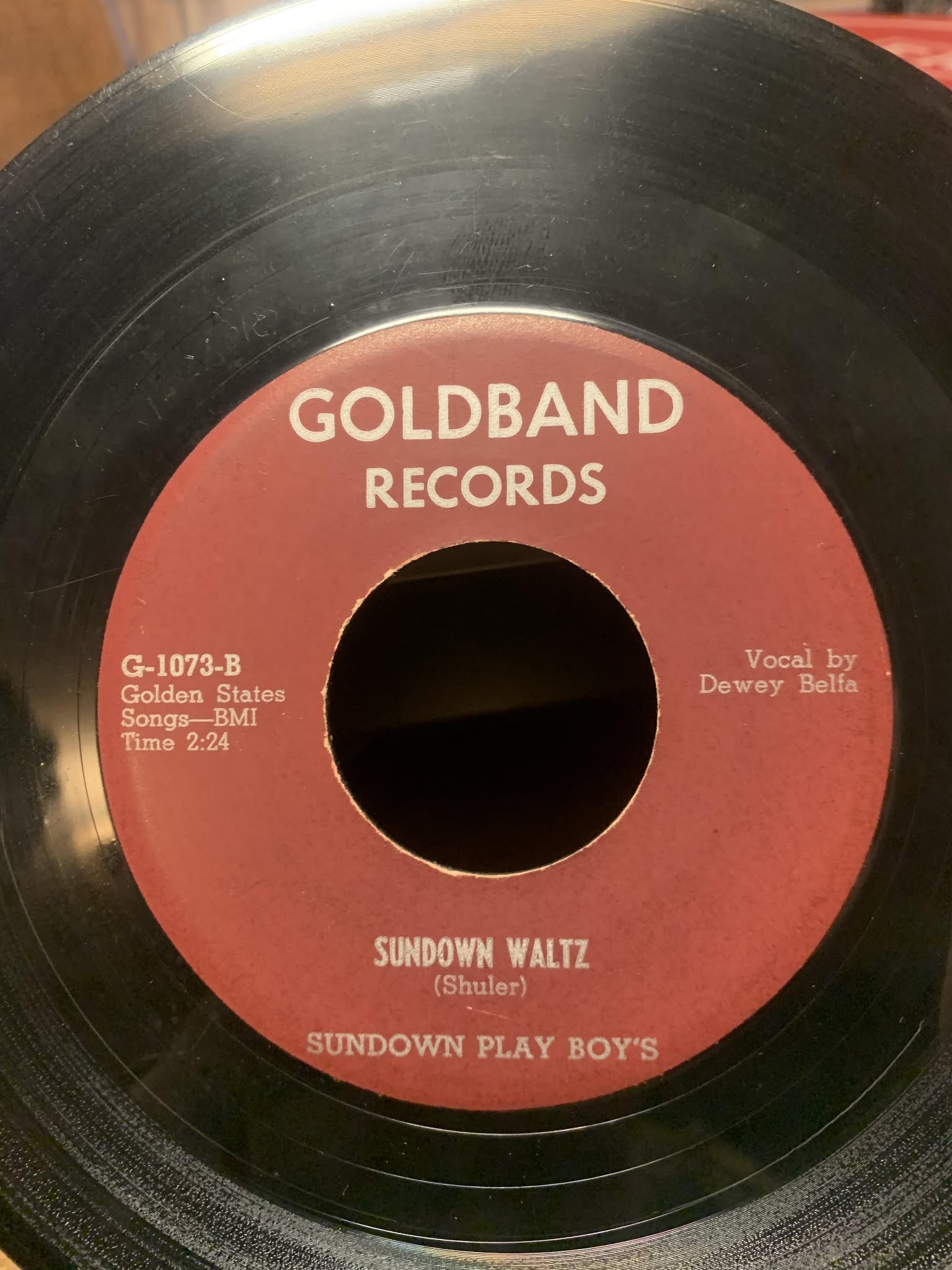
Lionel Cormier and the Sundown Playboys- "Sundown Waltz".


Inspired by the response to Iry Lejeune's records after his death, the 1950's found Eddie Shuler becoming more involved in recording Cajun Music. During these years he recorded Sidney Brown, J.B. Fuselier and Aldus Roger. Another great group he recorded was the Sundown Playboys.


The Sundown Playboys first started recording in 1951. Though they have gone though different members; The Sundown Playboys are the musical journey of the Lionel Cormier family.


Lionel Cormier learned the accordion from his father at a early age. By the time he 12, he was playing the accordion at house dances across Acadia Parish. In 1935 he settled in Elton playing a few house dances following World War II. He would begin playing with Percy Fuselier in 1947 and form the Sundown Playboys.


The group started out with Lionel on the accordion, Wallace "Red" Toucet on fiddle, Howard Mier on guitar, and Lesa on drums. Lesa was replaced on drums by Clifton "Tan" Benoit on drums when he served in the miltary from 1951-1953.


The group first recorded in 1951 on J.D. Miller's Feature label. Lionel was successful in landing radio airplay including places like KPLC in Lake Charles, KSUL in Sulphur and KJEF in Jennings. Their second recording was in 1956 at Eddie's Goldband studio. By 1955 Eddie Shuler was no longer depending on local radio stations to record his artists at. Eddie recalls:


"I built the studio in 1955, my father in law designed it. He was a carpenter, so him and his brother built the studio according to my specifications."


For their second recording the lineup for the Sundown Playboys had changed. Lesa Cormier ws back on drums after his military service. And fiddler Wallace Touchet was replaced with the great Dewey Balfa. Dewey recorded with the Sundown Playboys for their first two sessions for Goldband, but by the third session in 1959, Wallace Touchet was back on fiddle.


The mid 1950's found Dewey to be a in demand session player. It was then he started recording with Nathan Abshire, a recording career that lasted until Nathan's passing. He also recorded with Elise Deshotel during this time on the Khoury's label.


 Lionel and the Sundown Playboys recorded for Shuler's Goldband label from 1956-1959. "Sundown Waltz" was off the group's second recording session for the label in 1957. Lionel let Dewey handle the vocals on the track.


After their recordings for Goldband the group would return to recording for J.D. Miller on his Cajun Classics in 1960. But gone was Howard Mier and replaced with Lawrence "Blackie" Fruge. As for Lionel he would make one more record with the group in 1969 on the same label.


Lake Charles had started Cajun Days in 1967 and by 1971, it was hosted at the Bamboo Club on Highway 14 with Lionel and the Sundown Playboys as headliners. After finishing the song "Church Point Two-Step", Cormier died of a heart attack unexpectedly, while taking a break as KJEF radio announcer Jerry Dugas was making announcements between songs. 


The following Saturday night the band had a booking, so 15 year old Pat Savant joined to help. With Pat joining the group, the band headed in a new direction.


Session info:


LIONEL CORMIER AND THE SUNDOWN BOYS (1054, 1073)


Lionel Cormier (acdn), Dewey Balfa (v/fdl), Howard Mire (g), Larry Miller (st-g), 

Lesa Cormier (d)

Goldband Studio, Lake Charles, La; 1957

-A River two step Goldband 1073, Goldband(E) GCL110 

-B Sundown waltz Goldband 1073


Resources

John Broven- South to Louisiana

Wade Falcon- Early Cajun Music blog

http://wired-for-sound.blogspot.com/2011_11_24_archive.html

Ron Yule- Cajun Dancehall Heyday

Wednesday, September 23, 2020

Nathan Abshire- "Lemonade Song"

                                                    
The 1960's were the beginning of a Cajun Cultural renaissance. Interest in more traditional Cajun music emerged after years of Rock, Pop and Country influence and one of the leaders was a accordion pioneer; Nathan Abshire.


Nathan's popularity rose in the late 1940's recording for the Khoury's label. The label slowly faded out of the Cajun music scene and the beginning of the 1960's found him recording for J.D. Miller. While Nathan and his new band made some great recordings on the label; Nathan wasn't happy with Miller's antics.

By 1963, he wanted out. Floyd Soileau had started up a label and was having success releasing traditional Cajun music. Nathan approached Floyd about recording for Swallow Records in the mid 1960's. Sadly, Nathan was still under contract with Miller at this time. Nathan ended up hiring a lawyer to get out of contract with Miller to record with Floyd.

Floyd Soileau recalls:

“I went to see him when he was working at the Basile dump, People were starting to cover ‘Pine Grove Blues’ and I researched the song at BMI but couldn’t find it. Khoury never registered the song but Nathan had recorded it as ‘Pinegrove Blues’ for J.D. Miller. He registered it at BMI, but wasn’t paying Nathan royalties. I told Nathan that if he signed a publishing contract with me, I could get him his writer’s royalties. I took him to a notary and he put his X on a contract. I cleared the song with BMI. J. D. contested it, but I had a contract. J.D. claimed his got burned in fire. But Dewey Balfa, who played on the Miller sessions, said nobody signed anything with J. D.”

So in the 1965, Nathan gave recording another try. He assembled a band who had recorded with him earlier in the decade. Dewey Balfa had recorded before as a Pine Grove Boy and had a good working relationship and friendship with Nathan. Their musical careers would continue till Nathan's death. Junior Benoit and Thomas Langley were also mainstays in Nathan's band at this point.

In 1966 they entered Floyd's and recorded a number of sides at the Swallow studio in Ville Platte. Nathan knew he needed to cut some 45's to help with local bookings, so at this session; Nathan and the Pine Grove Boys reworked a song Columbus Fruge had recorded in 1929 as "Point Clear Blues". 

Moi j'aime cousin et moi j'aime cousine mais j'aime mieux la cuisinière.  
Samedi, ce soir, moi courir au bal, je m'ai saoulé comme un gros cochon. 
Dimanche matin, il est tout manière malade,
Passez lui le verre à limonade.

L'hiver arrive, l'hiver arrive, ton p'tit nég a pas de couverte,
Samedi, ce soir, l'ai courir au bal, je m'ai saoulé comme un gros cochon,
Dimanche matin, j'ai tout manière malade, 
Passez moi le verre à limonade.

Moi j'aime cousin et moi j'aime cousine mais j'aime mieux la cuisinière.  
Samedi, ce soir, moi courir au bal, moi saoulé comme un gros cochon. 
Dimanche matin, il est tout manière malade,
Passez moi le verre à limonade.

Nathan had paid tribute to earlier pre war Cajun songs before. He had transformed the Segura  Brothers "Mosquito Ate My Sweetheart" into "La Valse De Holly Beach"and turned "Fe Fe Ponchaux" into the "Musical Five Special". Previously, Leroy Broussard had recorded a version of the "Lemonade Song" in 1957 for Goldband, but it seems Nathan's version is the most well known version and rightfully so.

From 1965 to 1972 Nathan recorded for Swallow Records with great success and it seems these recordings are what he's best remembered for. Nathan hit his stride as a recording artist in these years, turning out a string of remarkable records for the Swallow label.

Floyd Soileau remembers:

“That was when I had my first little studio. “We did some things with the Balfas and some with other musicians Nathan rounded up.  If you sold 1,500 copies of a Cajun single, then you jumped up and shouted ‘Hooray.’ Most of Nathan’s singles did 1,500 to 2,000, with a lot being sold to juke box operators."

With this new success, Nathan appeared with Dewey Balfa and The Balfa Brothers at the Newport Folk Festival in 1967. Along with Dewey , Nathan devoted much of his time in the 1960's and 70's to promoting Cajun music through appearances at festivals, colleges, and schools throughout the United States. Nathan stayed with Swallow until the mid-1970's when Soileau slowed down his recording activities.


AND HIS PINE GROVE BOYS (10170, 10173 & 10175)
V-1/acdn, Dewey Balfa, Dewey Balfa and Will Balfa (fdl), Darius LeBlanc, Junior
Benoit (g), Thomas Langley (d)
Swallow Studio, Ville Platte LA: 1966


Resources
Picturing the Cajun Revival: Swallow Records, Album Art, and Marketing
Early Cajun Music Blog
https://64parishes.org/entry/dewey-balfa

Monday, September 7, 2020

Dewey Balfa and his Musical Brothers- "Valse De Balfa"

                            
When talking about the revival of traditional Cajun music, it's hard not to mention Dewey Balfa. Together with his brothers, Dewey helped introduced the sound of traditional Cajun music to people around the world.

During World War II, Dewey  left home to work in a Texas shipyard followed by a stint in the Merchant Marines. He played Texas swing, maintaining a heavy swing influence. It was here, being away from home where he felt the missing connection with his cultural music. In 1948, he returned to Louisiana and formed the Musical Brothers, a popular string dance band, with brothers Harry, Will and Rodney. By then Dewey had developed his own sound with his accurate, flowing style and was often requested to gig with other musicians.

By the 1950's, Dewey was a in demand musician. He began a lifelong association with Nathan Abshire. But it wouldn't be until the 1960's that Dewey would make a recording career with Floyd Soileau and Swallow Records. In 1963, Dewey approached Floyd about recording traditional Cajun music on his label.

At the first session for Swallow Records, Dewey and his brothers recorded a number of traditional songs. The second record they released was a number written by his brother, Will called "Valse De Balfa".

Quand j´ai parti de la maison,
J´avais fait mon idée,
J´étais parti pour te chercher, cher,
Où mourir au bout de mon sang.

Quand j´ai arrivé à ta maison,
J´en ai trouvé -z-un autre avec toi,
Ça, ça a cassé mon coeur, cher,
J´aimerais mieux mourir que voir ça.

Si j´aurais cinq jours dans ma vie,
J´en donnerais trois dans les cinq,
Pour passer las deux autres avec toi,
J´amerais mourir tes dans tes bras.

Like many traditional Cajun songs, the song is a haunting tale of one's love for another and his agony of seeing her with someone else. The song has had a lasting influence  and is still played by many to this day.

Louis Michot and the Lost Bayou Ramblers also recorded the song recently. Louis describes the song:


"La Valse de Balfa is one of those songs that draws anybody in who hears it. The pain and emotion is palpable, and the lyrics go straight to the heart."


 Later in 1964, he played at the Newport Folk Festival and played in front of 17,000 people. He continued recording traditional Cajun music for Floyd and others through the 1960's and 1970's. The Balfa Brothers played together until 1978, when Dewey’s brothers Will and Rodney were killed in an automobile accident. Dewey continued to play, and Rodney Balfa’s son Tony joined the group.


DEWEY BALFA AND HIS MUSICAL BROTHERS (10172, 10185)
Dewey Balfa (v/fdl), Will Balfa (v/fdl), Rodney Balfa (v,g), Harry
Balfa (g), Burke Balfa (triangle)
Swallow Studio, Ville Platte, LA; 1964

Valse de Balfa-1 Swallow 10185,

Resources:
Early Cajun Music Blog
with thanks to Louis Michot
Folkways.com
Lyrics-cajunlyrics.com

Monday, March 30, 2020

Nathan Abshire- Hoola Hoop Two Step

The end of the 1950's left Cajun musicians in a comprising situation. The years before found south Louisiana independent labels like Khoury's, Feature and Goldband finding success with their Cajun recordings. But by the end of the decade these labels were finding success in other genres.

J.D. Miller was one of those. By the mid fifties he was recording not only Cajun French but was recording more blues and swamp pop sessions. He was recording blues for Excello, rock and roll and R&B for his Rocko and Zynn labels.

Miller's interest in recording Cajun music again might have been sparked by the success that Floyd Soileau was having with Swallow records. At any rate, Miller started recording Cajun music again in 1959. And with the entrance back he grabbed one of the biggest recording artists for his new label. 

Nathan Abshire had recorded for Khoury's from the late 40's to the 50's. His last recordings for Khoury were in 1959, with "Cannonball Special" and "Red Rock Waltz". George Khoury was finding success with blues, R&B and swamp pop as well. His Cajun recording had slowed down to a trickle with some of his last Cajun recordings done by Pee Wee Broussard in 1959. But as far as Nathan, he was far from done.

After a uneventful decade since the success of "Pine Grove Blues" in 1949, Nathan saw his fortunes improve when he recorded for Miller during the early sixties. He had a modern Cajun band lineup augmenting his stunning accordion work. He went on to have a fine series of releases for the Crowley record man, whose production skills were as good as ever. On these recordings he brought the blues and honky tonk and released some of his more rock and roll output.


Miller started Cajun Classics with Nathan releasing the first sides on the label. He brought along a familiar friend in Dewey Balfa to these recordings. On Cajun Classics 101 he recorded "Hoola Hoop Two Step." Nathan was a big fan of The Segura Brothers. On Khoury's, he had reworked their song "A Mosquito Ate My Sweetheart" into "La Valse De Holly Beach". He did the same with his first recording on Cajun Classics. He reworked the Segura's "Rosalia" into "Hoola Hoop Two Step". The Segura's "Rosalia" itself was derived from Amede Ardoin's "Les Blues De Voyage". Nathan always seemed to have a way into reworking old classics and making them relevant.


Miller recorded some of Nathan's best material in the 1960's. He proved that he was still a driving force in Cajun Music. In his Miller recordings he brought back "Pine Grove Blues" with a new updated version. He reworked some old classics and introduced some new songs as well. But by 1965 he had left Miller and signed with Floyd Soileau's Swallow records. His Miller recordings seems to be overlooked for some reason, as his Swallow recordings are more well known. But the Miller years for Nathan are a definite high point in his career.
                             

Resources
Early Cajun Music Blog
John Broven-South To Louisiana
Thanks to Wade Falcon