

Floyd Soileau's first venture into the music business had paid off well. He had partnered with Ed Manuel on a 78 rpm and 45 rpm release on the Big Mamou label. This record featured recordings by Milton Molitor and Austin Pitre recorded at a local radio station and was a hit on the jukeboxes in South Louisiana.
Other artists took notice of the success of the record after its release. While Cajun music had been on a slow decline with the lack of labels putting out new material; this new label caught artist's attention. Many artists who had had success with recording on such labels such as Khoury's and Feature, were looking for someone to release their music. One of those artists was Lawrence Walker.
 Starting in 1955, Lawrence had been recording for George Khoury's label. Through the early 1950's he had released nine records on the label. But by 1955, Lawrence's last Khoury's was released. Rock and blues were gaining popularity and were the preferred styles being recording, leaving artists like Lawrence to the side.
 In 1957 Lawrence and his band traveled to Eunice to record four songs at KEUN radio station. Johnny Allan had just began playing with Lawrence at this time, playing steel guitar. The radio station would go off the air at night and allowed the band the studio to record there. Lawrence had heard about Floyd and brought the tapes to him. Floyd recalls:
"Lawrence said, "Well, I want to get some records made and I understand you're starting to make some records." And after I asked, "What do you want for the records? Do you want a royalty?" He said, "No, no, no, I had this royalty business a while back, I got shafted. I want $100 for that tape, got four songs on it." $100 back in 1956 was a lot of money, and I said, "Well, I know it's worth that, but I'm a little shy on some cash right now. How about if I buy two of the songs now and put them out , and I'll put the other two later." "Well," he said, "give me $50 now and the other $50 later on. If that's good enough for you, that's good enough for me." I said, "I'll go for that." So I had money and I gave him $50 and I clipped the tape, took the first two songs out."
So Floyd bought the songs from Lawrence with idea to follow up on his and Ed's first release. He went to Ed Manuel to see about putting out a new record. Ed wasn't interested, he had just wanted to do the one release to help out his jukebox sales. He offered Floyd some cash if he needed it, but Floyd had made enough off the first record to release Lawrence's record.
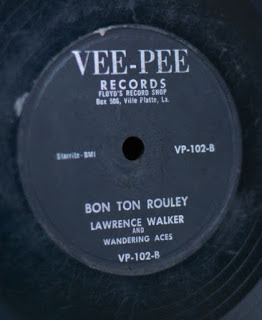 Not wanting to call it Big Mamou, Floyd decided on Vee Pee; a nod to his town of Ville Platte. He sent two songs to Starday in Nashville to press on the new label; "Osson Two Step" and "Bon Ton Rouley". As with the first record, Floyd put the name of his record store and address below the label title. Even though 45 rpm was desired new format; Floyd released the record on 78 rpm as well.
"Bon Ton Rouley" lyrics describe a young girl's parents not wanting their daughter to be courted with a older man. He speaks of travelling to Holly Beach and Hackberry with her; there, they get ate up by the mosquitoes only for him to shrug it off by saying "Let the good times roll".
C'est par rapports à ton papa et par rapports à ta maman,
Si moi j'peux p'us t'aimer, mais laissse le bon ton rouler.
J't'ai trouvè dans les grands mêches. j't'ai amené aux "Holly Beach",
Les maringoins sont aprés m'manger, mais laisse le bon temps rouler.
Ton pa pa il est fàcher et ta maman est pas contente,
Les marengoins sont aprés m'manger,
Mais laissse le bon ton rouler.
J't'ai trouvér dans les grande mêches, j't'ai amené aux "Hackberry",
Les maringoins sont aprés m'manger, mais laisse le bon temps rouler.
Ton papa aprés river, moi l'entende su' la galerie,
Ta mamam aprés quereller, les enfants sont aprés pleurer,
Les vaches sont pas tirés et les "gaimes" sont aprés chanter,
Les maringoins aprés m'manger, mais laisse le bon temps rouler.
 This new record by Lawrence on the Vee Pee label sold well and put Floyd in touch with more jukebox operators and music stores. After these two records, Lawrence didn't record for Floyd again. The other two songs that were part of the deal were later released. But as far Lawrence, he was recruited to record for La Louisianne records by Rufus Thibodeaux in the early 1960's. The Vee Pee label didn't last long with Floyd. He released one more record on the label before he had a new idea for a title for the label.
While the Big Mamou release was numbered 101, this Vee Pee record was numbered 102. A mix up at the pressing plant resulted in the label sides being swapped. "Bon Ton Rouley" is actually on the "Osson" side and vice versa.
Resources:
Conversations with Floyd Soileau
Early Cajun Music blog
Band photo: Center for Louisiana Studies
Ad: Early Cajun Music Blog
AND WANDERING ACES (Vee Pee 102)
V/acdn, U J Meaux (fdl), Johnnie Allan (st-g), Al Foreman (g), Bhuel Hoffpauir (d)
KEUN Radio Station, Eunice LA; 1957
VP 102-A Osson (Opelousas) two step Vee Pee 102,
VP 102-B Bon ton roulay (Les bon temps) Vee Pee 102,


