Showing posts with label Huey Meaux. Show all posts

Thursday, February 11, 2021

Andrew Cormier and the Rambling Aces- "Seventy Three Special"


Andrew Cormier was born in 1936 and raised in Church Point. Growing up, his father played the harmonica. On New Year's Eve he would go to his grandmother's house where they played the accordion, mandolin and guitar. He grew up working as a sharecropper on Roy Horecky's land. He grew tired of Roy and his slave driving ways and went to Texas.


He found a job driving trucks and delivering freight for his brother-in-law in Beaumont. While in Texas, his brother-in-law took him to a dance to see C.J. Broussard and the Band Busters. C.J. was playing the drums and Tan Benoit was playing the accordion. But later on C.J. and Tan got into a fight and Tan was fired, leaving Andrew to play the accordion.


Andrew went on to play at the 73 Club in Winnie where he met Huey Meaux, who was a barber at the time. At the time the original Rambling Aces consisted of Harry Trehan, Roland Ledet, Hillman Doucet, but Andrew soon took over the band. Rodney LeJeune soon joined the group after Hurricane Audrey pushed him into Texas to find work.


By 1958, the Rambling Aces in Winnie consisted of Andrew, Rodney LeJeune,Roland Ledet, Chat Deville, Aaron Higginbotham with Huey Meaux on drums. The group cut their first record for Floyd Soileau's Swallow Records. "The Seventy Three Special" and "Dans La Misere" was recorded at KPAC radio station in Port Arthur and sold a astounding 500 copies. 


Hey tite monde, moi je assis moi tout seul

Plus personne pour m'aimer moi tout seul

comment je vas faire

Oh malheureuse moi je assis sur l' borde mon lit 

Mon chaplet dans ma mains apres prier pour tu t'en viens


Oh tite fille moi je assis moi tout seule

Moi j' aimerais tu t' en viens une autre

fois avant mourir

Oh chere tite couer moi je assis moi

tout seul

Moi j'aimerais tu t’en viens nous rejoinde

au seventy-three


At this point Huey wasn't just the drummer for the group, he was acting as the manager for the group. He was the one who got in touch with Floyd Soileau at Swallow Records. Floyd recalls:


"Huey was a disc jockey in Texas and he played some of our music over there on that radio station. Then he decided he wanted to make a little bit of money as a booking agent for these bands, and so he started recording them at the radio station and he wanted a label to put it on, so he sent me the copies of the tape and said "If you want to put 'em out, you can put 'em out." So, I did."


Andrew would cut two more records for Swallow before joining Huey Meaux's Crazy Cajun label. Andrew and the Aces went on to set the standard for the Texas dancehall scene, playing at the Rodair Club for 28 years.


One night at the Rodair Club, Andrew's idol, Lawrence Walker, came to see Andrew play. Andrew remembers:


He called me 'Tit Boy. I asked him, "Nonc Lawrence, do you want to play a couple of songs?" He said, No, not now." So I played a couple songs and then Lawrence got on the bandstand and told me, "I'd never thought when you was a kid that you'd pick up on my style."


Cajun musician and historian, Michael Dupuy reports that there are two recorded versions of this song with different lyrics and instrumentation.


Resources

Thanks to Michael Dupuy for help and guidance

Lyrics- Michael Dupuy

John Broven- South to Louisiana

Ann Savoy- Cajun Music Vol 2.

photos-Ann Savoy: Cajun Music Vol 2

interview with Floyd Soileau


Session info

HUEY MEAUX - ANDREW CORMIER AND THE RAMBLING ACES

(Jin 104 and 106)

Andrew Cormier (v-2/acdn), Rodney LeJune (LeJeune) (v-1/d), Shaw-ee Deville

(fdl), Aaron Higginbotham, Roland Ledet (g), unknown g

KPAC Radio Station, Port Arthur TX: 1958

J8OW 7466 Seventy three special-2 Jin 104

Wednesday, July 8, 2020

Joe Falcon- Corrina, Corrina


After December of 1937, Joe Falcon's recording career ceased. Many factors contribute to this, from feeling cheated by record companies to having to take care of ailing family members. But Joe didn't necessarily need to record. He had built up his reputation from his first 1928 recordings to his continued recordings until 1937. Joe could have easily rested on his legacy as one of Cajun music's leading artists, but he continued performing.

Cajun string bands found themselves competing for the same venues as big brass and bigger Texas String Bands and soon many groups started increasing the numbers in their small groups. As for Joe, he formed his Silver String Band as a result of this in the late 1930's.

This group continued playing in the area until the early 1960's. Joe still drew a good crowd at the dances he played bring in old and new fans. And for the band it had changed over the years. After his first wife, Cleoma, had passed away in 1941; Joe remarried. He married Therese Meaux, whose nephew was Huey Meaux. Therese took over drumming duties in the band after the regular drummer failed to show one night. Joe's brother in law, Clifford Breaux had played in the Silver String Band until he passed until 1960. Then Lionel Leleux took over fiddling duties in the band.

By the summer of the early 1960's Joe was still playing dances almost every weekend. He had not made any records since 1937 and kept busy with these weekend shows. In 1963, Joe was playing at the Triangle Club in Scott. While Joe had been reluctant to record for the local recording labels, he had agreed to let Lauren Post's wife record him playing live at the club. The album was released by Chris Strachwitz's Arhoolie label in 1968.


 Typical of most groups at the time, Joe's band played a variety of music styles at their shows. They played the country songs popular of the time as well as many of the Cajun music classics. From the recording, Joe performed"Corrina Corrina". The song has a long history but was popularized by groups in the Western Swing era. Fiddler Leo Soileau also recorded the number during a Decca session in 1935.

The recording is not anything spectacular by any means. But considering it was made with one microphone standing on a table near the bandstand, its quite a remarkable recording. All the instruments were amplified except the drums and the sound came over the house PA system. After this show, Joe would play one more dance and would quit performing live due to declining health.

The recording of this show is significant as it gives us a glimpse into the earliest field recording of a Cajun band in a Cajun dance hall. The recording also provides insight into what a dance hall sounded like during the Cajun Honky Tonk era of the 1950's and 1960's.


Therese's nephew, Huey Meaux, had started his own record label called Crazy Cajun in the 1960's. He released artists such as Andrew Cormier and the Rambling Aces in the labels early years. He released a couple of Falcon-Breaux releases on his label as well. This 45 on Crazy Cajun 514 was the first with two more Falcon-Breaux releases afterwards.


Resources
Wade Falcon
liner notes Arh. 459

Saturday, June 20, 2020

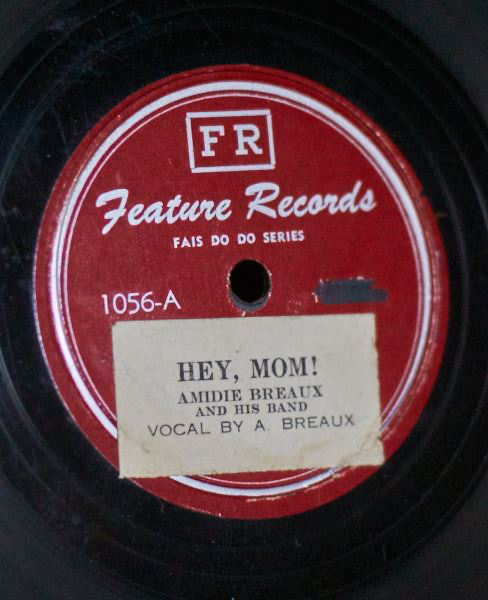
Amadie Breaux-"Hey Mom"

Between 1929 and 1934 the Breaux Brothers had a short recording career and together they recorded some of the earliest versions of Cajun music standards. After their 1934 session they did not record again commercially. 

In the late 1930's, J.D. Miller had played music with the Breaux's until he went into the service and got married. He started his Fais Do Do label in the late 1940's, eventually changing the name to Feature Records. By this time accordion music was making a comeback, so Miller convinced Amedie and Ophy to record for his label in 1953. They recorded a Mayuse LeFleur and Leo Soileau song and changed the name to "Hey Mom!". 


The song was originally recorded as "Mama Where You At?" by Mayuse and Leo in 1928 and Leo recorded it again in 1936 as "A Ute" for Decca Records. The original Feature pressing had a mix up with a Cleveland Mire session leading to Miller having to apply stickers to the Breaux release of "Hey Mom!".

The recording was made in Miller's studio in Crowley. Amadie and Ophy had recorded previously with Miller in 1950 and this 1953 recording would be the last one. The session itself has been up for debate among collectors and researchers, mainly due to the lack of info of the other performers on the recording. While we know Amedie and Ophy are present, the other musicians are unknown.

With the rise of independent record labels in the late 1950's and 1960's, Huey Meaux started his own label called Crazy Cajun. There he released recordings by The Rambling Aces, Clifton Chenier and Alex Broussard. Huey's father, Te-Tan, played the accordion and also had releases on Crazy Cajun as well. 

Huey's sister, Theresa, married Joe Falcon and played drums in his band. Huey even put out a 45 of Joe and his Silver String Band which included Theresa on drums from a live recording Chris Strachwitz made. The Falcon-Breaux connection continued with a release of a odd mix up of a Joe and Cleoma Columbia session backed with a Decca session. Huey released the Joe and Cleoma on Crazy Cajun 523 and Amedie's "Hey Mom!" on Crazy Cajun 522.

Oh mam, éyoù toi t'es?
Chère mam, j’aimerais te voir,
Une fois avant de mourir,
Chère mam, j'aimerais te voir yaille.

Oh mam, éyoù toi t'es?
Chère mam, j’aimerais te voir,
Une fois avant de mourir,
Chère mam, hé yé yaille. 

Oh mam, éyoù toi t'es?
Chère mam, j’aimerais voir,
Chere mam, éyoù toi t'es?
Chère mam, j'aimerais te voir yaille.

Huey's reissue of Amadie Breaux's "Hey Mom!" isn't a standard reissue by any means. Judging by the sound of the 45 rpm, it sounds like Huey held a microphone to the speaker while the 78 rpm played on a turntable. It was released in the mid 1960's and now has become a sought out 45 rpm. Later on in the 1970's Huey continued the Breaux connection by releasing records by Pat and Gary Breaux.


Resources
Early Cajun Music blog
Vermilion Today article

Wednesday, April 22, 2020

Marc Savoy and Dallas Roy with the Rambling Aces- "Prison Waltz"


In the 1940's Cajuns moved to East Texas cities like Port Arthur to follow the work demand. They brought their language and culture with them, playing at clubs around the area. The Rambling Aces played at many of these surrounding clubs including the Rodair Club.

During the 1950's and 1960's the climate in the US was perfect for independent operators. Huey Meaux of Crazy Cajun Records was one of them. Huey Meaux had convinced Floyd Soileau to release The Rambling Aces on Jin Records with their first release selling around 500 copies.

After a stretch with Soileau, The Rambling Aces began recording for Huey Meaux's Crazy Cajun label. Huey had started the label and the first several releases were those of the Rambling Aces. As they began recording and releasing their music, their popularity gained. Fans in Louisiana would make the 300 mile round trip to the Rodair Club in Port Acres on any given Saturday night. With the Rambling Aces, Meaux was involved as a manager and master of ceremonies at club dances. 

Marc Savoy was born near Eunice and growing up he fell in love with the accordion. When he was 12 he made one out of household items. Later on his father bought him a new accordion from the Sears Roebuck catalog. When he wasn't playing it, he was disassembling and reassembling it to see how it worked. Marc first met Andrew Cormier in 1964 when he made the trip to east Texas to hear the band at the Rodair Club. Marc was impressed by the musicianship of the band and with Andrew. The two hit it off and a life long friendship was formed.

Marc recorded with The Rambling Aces in two sessions. The first was in 1963 and the second was in 1964. While Andrew was primary accordion player for the Aces; Marc is the accordion player for these 2 sessions. The session in 1964 produced a number of recordings, including the "Prison Waltz".

On the recording were Dallas Roy on vocals, Rodney Lejeune on guitar, Marc Savoy on accordion, Walter Miller on fiddle, Raymond Cormier on steel guitar and Lionel Blanchard on bass guitar.

Dedans la prison, assis dessus mon lit,
après jongler à toi, tite fille comment j'vas faire.
O yéyaie, mon cœur est tout brisé 
après jongler à toi, catin, mais moi, j'm'en vas.

Hé, petite fille, quoi faire t'es comme ça? 
Aujourd'hui t'es après me quitter, 
'tite fille, tu veux plus me voir. 
Oh yéyaie, mon cœur est tout cassé,
dedans de la prison, comment j'vas faire?

This version is similar to "Prison Waltz" by Cleveland Mire recorded in 1951 and Lawrence Walker's "Creole Waltz". While there are many instances of the same melody used for different songs, the lyrics can vary. Canray Fontenot used a similar melody on "Les Barres De La Prison" which itself was based on Douglas Bellard and Kirby Riley's "La Valse La Prison" recorded in 1929.The Hackberry Ramblers recorded  a version of the song, "La Valse De Prison" in 1938.


Resources
Marc Savoy
Micheal Dupuy
John Broven- South To Louisiana
Wade Falcon-Early Cajun Music blog
lyrics- Stephane G.

Monday, April 6, 2020

Ed Kershaw- La Lake Arthur

The Kershaw's were a family filled with Cajun musicians. They were originally from Tiel Ridge at the tip of Cameron Parish and were a family of trappers and fishermen. 

The father, Jack, played accordion and fiddle and mother Rita played almost any instrument. The boys, Nelson "Pee Wee" and older brother Edward learned the accordion by being around the music. In a short time Edward got a guitar and Pee Wee learned the drums and fiddle. Doug began playing the fiddle at the age of five with Rusty playing the guitar. 

Following their father's death in 1943 the family moved to Lake Arthur. The brothers scraped up money as they could. They shined shoes and played music to make a little money. In 1947 the brothers formed the Continentals playing throughout the area. Edward played the drums from time to time with them.

Not much is known about Edward's life after these years. But in 1962-1963, his brother Pee Wee recalls that Ed, who was living in Port Bolivar, Texas, at the time, recorded two songs at Huey Meaux's Sugar Hill studio in Houston. 

The two songs were "Mama and Papa Waltz" and "Big Ed's Special". Ed's brother recalls the same songs were released on Goldband as "Gran Pa and Grand Ma Waltz" and "La Lake Arthur," but no information is known on how this occurred. Rusty played the guitar, Doug was on fiddle, Pee Wee played the drums, and Ed played the accordion on this session.


Resources
John Broven- South To Louisiana