Showing posts with label Eddie Shuler. Show all posts

Sunday, January 9, 2022

Leroy Broussard- "Lemonade Song"


The history of Cajun music is filled with songs that have been passed down, borrowed from and rearranged. "Lemonade Song" is among those songs and is filled with interesting history.

The song's beginnings start with a recording by Columbus Fruge in 1929 called "Point Clear Blues". Jimmie Choates transformed the song into "Petite Negres" in 1948 along with Blackie Dartez. The song was recorded again in 1957 by a musician from Rayne who named it as "Lemonade Song".


Leroy Broussard was born November 8, 1921 to parents who played the accordion. Like many families, Leroy's family made the move from South Louisiana to Texas following work. Growing up, Leroy listened to Nathan Abshire, Lawrence Walker and J.B. Fuselier. When Leroy was twelve years old he moved back to Louisiana and for a while even played with Nathan Abshire.


He moved back to Texas in 1948 and started playing with Joe Cormier's band; playing every day except Monday's. Leroy recalls:


"They'd come from Houston, they'd come from all over, and they went for the French music. They had people who had come to that bandstand and said they had never heard it, but they liked it."


Leroy and his band, The Happy-Go Luckies, became a big hit at the B.O. Sparkle Club around this time. He continued to play in Texas for nine years, then he quit. He came back to Louisiana and worked in the oilfield for some time, then he started working for the city of Lafayette and began playing music again. He would eventually return to Texas and run the Sparkle Paradise for a while.


After 1955, Eddie Shuler was focused on recording more Cajun musicians. He had had some success with Sidney Brown's accordion based recordings and was open to record Leroy when he came to his studio and recorded "Lemonade Song".


Moi j'aime cousin et moi j'aime cousine mais j'aime mieux la cuisinière.  

Samedi, ce soir, moi courir au bal, je m'ai saoulé comme un gros cochon. 

Dimanche matin, il est tout manière malade,

Passez lui le verre à limonade.


L'hiver arrive, l'hiver arrive, ton p'tit nég a pas de couverte,

Samedi, ce soir, l'ai courir au bal, je m'ai saoulé comme un gros cochon,

Dimanche matin, j'ai tout manière malade, 

Passez moi le verre à limonade.


Moi j'aime cousin et moi j'aime cousine mais j'aime mieux la cuisinière.  


Samedi, ce soir, moi courir au bal, moi saoulé comme un gros cochon. 

Dimanche matin, il est tout manière malade,

Passez moi le verre à limonade.


Moi je bois du vin et moi je mange des dattes, et tout ça, ça me coute pas rien,

Samedi, ce soir, l'ai courir au bal, je m'ai saoulé comme un gros cochon,

Dimanche matin, j'ai tout manière malade, 

Passez moi le verre de Kary-On.


His band at this time consisted of himself on accordion, Freeman Hanks on fiddle, Robert Thibodeaux on drums and Charlie Babineaux on guitar. Leroy and his band would record only four songs at Goldband studio, he would go on to record for La Louisianne and also Kajun Records. He would continue to claim he wrote "Lemonade Song". One night Leroy met legendary accordionist, Moise Robin at a bar and struck up a conversation about songs. Leroy insisted he wrote the song and Moise reminded him that Columbus Fruge wrote it first. The argument became heated and Moise told Leroy:


"I told him, "You're wrong!"  He got angry.  I said, "Okay, but someday I might find 'Boy' Fruge's record, and even if I have to go to your home, I'll find out where you live and I will show you that it's not you who made that record."


Resources:

Ann Savoy- Cajun Music Volume 2

Wade Falcon- Early Cajun Music blog


Session info:

LE ROY BROUSSARD & HIS FRENCH ACCORDION BAND (1048) 

V/acdn, Freeman Hanks (fdl), Charlie Babineaux (g), Robert Thibodeaux (d), 

Goldband Studio, Lake Charles LA; 1957

-A Lemonade song Goldband 1048


Saturday, December 11, 2021

Iry Lejeune- "Come And Get Me"


On December 9, 1929, Amede Ardoin and his partner, Dennis McGee, recorded their first recordings in New Orleans. The very first song they recorded was a number called "Taunt Aline". Ardoin's popularity took off after their first recordings and the music influenced generations to come. One of those influenced was a young boy named Iry LeJeune.


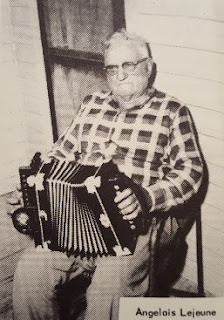
Iry grew up fascinated with the music he heard around him. His great uncle, Angelas Lejeune, was one of the top accordion players in the area. Like McGee and Ardoin, Angelas had recorded in the 1920's as well, recording for the Brunswick label. At the sessions, Angelas would record "La Valse de Church Point" and the first recording of "Perrodin Two Step". Playing with him on the sessions were Dennis McGee and a Church Point fiddler named Ernest Fruge.


Iry would visit Angelas who lived just a mile away and it was there Iry learned how to play the accordion. Angelas also introduced the young Iry to the sounds of other accordion players. At his home, Angelas had a phonograph player and played Iry 78's of other players such as Amede Ardoin, Joe Falcon and Amade Breaux. Iry would sit and listen and study these records, retaining every note in his head. Surely it was there that Iry first heard Ardoin and McGee playing "Taunt Aline".


By 1954, Iry had recorded and released several records. The band kept busy with playing clubs across the area as well. They would play the Blue Goose in Eunice and at the Shamrock Club. Milton Vanicor recalls Nathan Abshire stopping by the Shamrock and playing with Iry and the band one night. Iry would also play at the Red Barn Club in Texas and the China Ball Club in Bristol. Luderin Darbone recalls Iry stopping by the Silver Star to listen to the Hackberry Ramblers from time to time.


In 1952, Eddie had recorded Iry at his home on his reel to reel recorder. He returned in early 1954 to record another session for upcoming releases. The recordings were made over several dates and included Iry, Wilson Granger and Alfred Cormier. For one of the songs they recorded, Iry drew inspiration from Ardoin's "Taunt Aline" and used it for his song, "Come and Get Me".


Oh ye yaille, chere tit monde, catin,

Mets-toi voir bien jongler

Ca t'as fait.

C'est pas la peine

Que tu le lamentes.

Viens donc me chercher, ye yaille.

Ton papa va venir.

Je peux pas aller t'apres.


Oh, tite fille, c'est tous les soirs,

Je me couche.

J'embrasse mon oreiller

Des fois en jonglant,

Faire des accroires que ca serait toi

Qui serais la, ye yaille.

Mais, tout je peux voir,

Tu t'en reviendras pas

Me revoir.


Iry's version of the song tells about a young man lamenting that his "catin" won't come back since her father brought her back home. He sings of the young man kissing his pillow and believing in is her beside him. The song was also known as "Viens Me Chercher".


Iry's 1954 recordings would be his last for Eddie Shuler. His recordings for opened the doors for many other artists to record. Eddie was known to often say that Iry never made a record that wasn't a hit and by the mid 1970's, Iry Lejeune's records were still the most popular of the Goldband artists. As for the melody of "Taunt Aline" and "Come and Get Me", it would go on to be used by The Balfa Brothers for their 1974 recording "J'Sus Orphelin".


Resources

Ron Yule- Wailin The Blues Cajun Style

Wade Falcon- Early Cajun Music blog


Session info


V/acdn, Wilson Granger (fdl), Alfred Cormier or Eddie Shuler (g)

Lejeune’s house, Ardoin Cove, Lacassine LA: 1954 


Come and get me Gb1057

Sunday, December 27, 2020

Sidney Brown- "Sha Ba Ba"


Eddie Shuler founded Goldband Records in 1945 originally to record his own group. But by 1948, he began releasing Cajun music on his Folk Star label, intending it to be a "folk" type of label. Eddie had found that jukebox operators would only buy so many copies of one label; so having two labels would spread out the profit.


One of the first releases on Folk Star were recordings of Iry LeJeune. Based on the success of Iry's recordings, Eddie started recording more Cajun artists. After Iry's death, Eddie needed another artist to record Cajun music in his place. One of those artists in the mid fifties was Sidney Brown.


By 1948, Sidney Brown had moved to Lake Charles and formed the Traveler Playboys. He was working in town at a woodworking job, eventually using the skill to repair and make accordions. Sidney and his band also had a thirty minute program on KPLC radio at this time.


Sidney's first recording Folk Star was "Sha-ba-ba (Dear Baby)". The record is one of many with misspelled tittles, the correct spelling is "chere bebe".


Ouais, catin, 'garde donc mais ça t'as fait,

Ouais, 't'après me quitter, mais ouais pour t'en aller.

Ouais, t'en aller rejoindre un autre que moi.

Ouais, vilaine manière, tu connais tu vas du regret.


Ouais jolie catin, rappelle toi les promesses, chère,

Et tu m'as fait, mais ouais y a pas longtemps.

Ouais, (z)aujourd'hui, c'est te voir après me quitter,

Ouais, chère bébé, moi je connais t'auras du regret.


On this song, Sidney sings about a lover leaving, knowing she will regret it as she walks away. This first record's success led to Eddie moving Sidney from his Folk Star label to Goldband. Sidney and his band would record many sides on Goldband from the mid fifties to 1960.


Originally issued on 78 rpm, this release is thought to be a later issue on 45 rpm. On both versions it is noticeable that Eddie assumed songwriting credits for the song. Also noticeable is the record was pressed by Starday's publishing company, Starrite.


Concerning the publishing, Eddie recalls:


"And, at that point in time, I’d met Don Pierce in Nashville, him and Daily had formed Starday and moved it to Nashville. Don Pierce had come off the West Coast. Don was helping me out, supplying me with a little extra finances, so with him I formed this publishing company."


Sadly by 1960, Sidney's hand was bothering him, leaving him unable to play as he once did. He focused on repairing and building accordions during this time. But his first recording on Folk Star would be one of his biggest selling records.


Resources:

http://wired-for-sound.blogspot.com/2011_11_24_archive.html

Early Cajun Music Blog

Ron Yule-Cajun Dancehall Heyday

http://www.bopping.org/starday-custom-series-1953-1960-an-introduction-how-did-a-flourishing-small-label-to-operate-on-custom-releases/


Session info:

SIDNEY BROWN

AND FRENCH ACCORDIAN 

Acdn, Nelson Young (v/fdl), Wallace Ogea, Eddie Chapman (g)

Goldband Studio, Lake Charles LA; 1955

-A Sha-ba-ba (Dear baby)-1 Folk-Star GF1132


Monday, October 12, 2020

Boozoo Chavis- "Hamburgers and Popcorn"


 "Boozoo" Chavis was born Wilson Chavis on October 23, 1930 in the Doghill section of Lake Charles. He was playing accordion and harmonica at the age of nine years old. He was influenced by several local Creole accordion players and soon he was playing at various social functions by his teenage years.


He acquired the nickname "Boozoo" in his childhood, although the origin of the nickname is unknown. When asked by a reporter about his nickname, Chavis replied "Man, I hate that question". His mother opened a dance club in 1944, where ‘Boozoo’ could sit in with Maurice Chenier and his sons Clifton and Cleveland, picking up techniques from the early zydeco masters.


After Iry LeJeune's death, Sidney Brown was Eddie Shuler's star accordionist. Sidney heard Boozoo playing and recommended him to Eddie. At this time Boozoo played by himself, keeping time by stomping his foot on a Coke box.


Eddie recalls:

"Sidney heard this boy out in the country that had a pretty good song. He brought Boozoo by and we recorded "Paper in My Shoe". 


Eddie first wanted Sidney Brown and his band to back Boozoo on his recordings, but Sidney told him he couldn't play that kind of music. Sidney told Eddie that it wasn't Cajun music, that they called it Zydeco. Eddie hired a local band to back Boozoo on the session.


The first recordings in 1954 did so well that soon, Imperial Records leased the master for national distribution. It wasn't long after that Imperial wanted more songs to release. But Boozoo wouldn't make any more records because he hadn't got paid from the previous sessions. The record sold well all over the country, but when Boozoo saw the paltry royalty check it brought him, he thought it was so disgraceful.


Eddie finally got Boozoo 700 dollars for the recordings and he cut two more songs to be released. Sadly, Imperial wasn't interested in the new material and momentum was lost. As for Boozoo, he went back to the horses and would come by the studio to record something every once in a while.


It wouldn't be until 1960 that Boozoo would record again. He released "Hamburgers and Popcorn" on Eddie's Goldband label. The song started out as a instrumental and Little Brother Griffen's vocal was added later.


 Boozoo spent the next thirty years training racehorses, before he signed a contract with the Maison de Soul label in 1984. With a sandpaper voice and a hypnotic single-note riffs, Boozoo took zydeco back to an earlier style compared to the current output of the time. Boozoo recruited his sons Charles on ‘frottoir’ and Rellis on drums into his backing band The Majic Sounds.


Session info 

Goldband 1161

Hamburgers and Popcorn

Vocals- Little Brother


Resources

https://www.allaboutbluesmusic.com/boozoo-chavis/

Liner ntoes to The Lake Charles Atom Bomb

https://en.wikipedia.org/wiki/Boozoo_Chavis

Early Cajun Music Blog


Friday, June 12, 2020

Iry LeJeune- Duraldo Waltz


By 1954, Iry LeJeune was no stranger to recording. His fascination with commercial recordings stimulated his desire to record. Unable to work on the family farm due to his poor vision, Iry spent time playing devoloping his style by playing along with his 78 rpm records on his phonograph. 


A good example of Iry's connection to commercial recorded music is "Love Bridge Waltz". Iry used the melody of a 1929 recording from Delin Guillory and Lewis Lafleur song called "Alone at Home" for his song.

While the Guillory and Lafleur song was recorded in 1929, it wouldn't be until 1940 until it was released. The delay of this record release; in conjunction with the Lee Sonnier's Acadian All Stars post war releases, sparked the accordion revival that thrived in Cajun Country following World War II.

Iry first recorded with the Oklahoma Tornadoes, after Sonnier's Acadian All Stars groundbreaking collaboration with Happy Fats. Afterwards, Iry was  constantly asking Eddie Shuler to record him. Iry recorded again with two sessions at KPLC in Lake Charles. After these sessions, Eddie Shuler bought a reel to reel recorder and began recording Iry at his house.

Eddie explains:
               
      "I bought a tape recorder, and it cost $237, which was a lot of money in those days.
       We would put the machine on the kitchen table and cut these things..."

It was at the 2nd session at Iry's house that he recorded "Duraldo Waltz". The song was brought to the session by fiddler Wilson Granger. He had the song in his head from hearing his father play it around the house. Wilson whistled the tune to Iry and he made up some lyrics on the spot. Duralde is a small community outside of Eunice where Iry often played at.

There were two recordings of the song released, with two slightly different lyrics. But on the song Iry put down the accordion and let Wilson's fiddle playing shine. Iry often would call out to Wilson on the recordings; saying "Eh Pill" for Wilson's solo. Iry would call him this because Wilson had severe headaches was constantly taking Aspirin.


The song was recorded at Iry's home in the kitchen with the reel to reel on the kitchen table. Those present at the session were Iry, Wilson Granger and Alfred Cormier. Iry had a family dog named Rain, that was there at the session as well. During the recording, someone came to the door and Rain barked at them. On this version of the recording, Rain's bark was left on the recording; the other version Shuler released had different lyrics and was missing Rain's bark.

Over time people would approach Shuler and ask him about the dog on the recording. It seems odd to why Shuler would release two different versions. Eddie was also known to turn on the recorder and record the band while they warming up. He would release these recordings as well as recordings he spliced together. This record continues in Eddie's tradition of assuming song writing credits for songs he clearly did not write.

Iry would continue playing and recording until his death. He got tired of Eddie's antics and bought himself a recorder to record and release his material. By mid 1955 he was playing around Lake Charles when Wilson quit him to pursue other interests. Iry turned to his old friend, J.B. Fuselier to help him out on the fiddle. One night they were coming from a dance in Eunice and the car had a flat. A incoming car struck them and killed Iry and seriously injuring J.B.


Resources
Ron Brown- Iry Lejeune:Wailing the Blues Cajun Style
Early Cajun Music Blog
Ryan Brasseaux- Cajun Breakdown

Monday, April 13, 2020

Iry Lejeune - Church Point Breakdown


Iry Joseph Lejeune was born October 27, 1928 into a musical family of country farmers. At a early age, it was noticed that Iry had impaired vision that seemed to follow the Lejeune family. At a early age he began playing the harmonica. Then at age 6 he began playing the accordion. He began playing on his father's accordion even though his father was worried he would break it. Iry went wherever he could to hear and learn accordion. He learned most of the time from his father and his great uncle, Angelas Lejeune.

On a trip to New Orleans during 1946, Iry began he began playing in a bar where he  received $50 dollars a night plus tips. Floyd Leblanc's group, The Oklahoma Tornadoes, were playing next door. Iry met up with Floyd and was soon playing with his group. Bennie Hess played guitar in the group and was in the process of starting a record label in Houston. Iry's first record was on the label of Hess's. After the recording, Iry kept busy playing  around the house.

After Iry's first recordings, his music begain to take off. Iry met Eddie Shuler at the time when Eddie's band had a show on KPLC. He wanted Eddie to put out his records out and the pair worked out a deal and soon Shuler was putting out Iry's records. He was even recording Iry at his home.

Eddie recalls:

"I bought a tape recorder, and it cost $237, which was alot of money. We went to Iry's house when we first started,
and he lived in a old house out there in Lacassine. We'd put the machine on the kitchen table and cut these things..."

The first session at Iry's home in Ardoin Cove was recorded on Shuler's reel to reel recorder. Playing with Iry on the session was Milton Vanicor on fiddle and Eddie Shuler on guitar.  The first sessions were recorded in one night and was believed to be recorded in November 1952. 

"Church Point Breakdown" was a ode to the town of Church Point, not far from where Iry grew up. Iry converted Angelas Lejeune's "Le Petite One Step" into his own the number. Its one of the few Iry releases that Eddie pressed only on 45rpm.

"Eh ye yaille, malheureuse!
Tous les jours dans ma maison,
J'apres mais t'esperer.
Eh, rappelle-toi, catin,
Ton papa et ta maman t'a toujours
dit
De pas faire ca avec ton negre.

Eh ye yaille, tous les jours
Apres souffert dans ma maison
Plus personne qui vient me
rejoindre.
Tite fille, tous les jours tu connais
Pour venir puis voir
Quo faire que, moi, j'suis la'.

Eh, bebe, tous les jours
Moi j'suis la sus ma galerie
Apres esperer pour ton vieux

negre.

Oh, tu devrais jamais m'oublier
'Tant loin q'moi j'm'en vas te dire
Donc garde donc j'm'ennuie de toi"


Shuler continued recording Iry and releasing his records. Iry was known to never limit himself to traditional sounds. Luderin Darbone recalls that Iry came by the Silver Star to the listen to the Hackberry Ramblers from time to time. In the summer of 1955, Iry began to team up with his old pal, J.B. Fuselier, who had moved to Lake Charles. They were finishing a Friday night dance at the Green Wing Club in Eunice, and was returning to Lacassine when hey had to stop and fix a flat tire. They were hit by a speeding car and J.B was injured, Iry was killed instantly.

Resoureces
Ron Yule- Wailin The Blues Cajun Style

Tuesday, March 24, 2020

Sidney Brown- "La Misere De Mon Beau-Pere"

Sidney Brown was born October 28, 1906 in Church Point. Growing up, he  was self taught on the accordion. He would borrow a accordion and sit in the field and play. By the time he was 13, he was already playing house dances and fais do-dos. 

After years of working in the oilfield as a roughneck, he moved to Lake Charles from Ville Platte in 1940. There he found work as a woodworker and carpenter. It was here that Sidney began developing his skills towards making and repairing accordions. He would eventually be recognized as the first person to build Cajun accordions after WWII in Louisiana.

After World War II he formed the Traveler Playboys. In 1948 they played on KPLC on a weekly 30 minute broadcast. From 1952 to 1959, Sidney performed with the Musical 4 + 1 and the Hillbilly Ramblers, as well as his own bookings. 

In 1955, Sidney and his band began recording for Eddie Shuler. Eddie had been inspired by the success of Iry Lejeune's records and became more involved in recording Cajun music. Sidney's record "Pestauche A Tante Nana" would become the third best selling record in the history of Cajun Music. Sidney and his band played many clubs in Louisiana and Texas. They also appeared on KPLC radio with the Israel Lafleur Show and on KPAC television in Port Arthur.

"La Misere de Mon Beau-Pere" ( My Father-In-Law's Sorrow) was recorded in 1958 at Goldband studio in Lake Charles. Playing with Sidney on the recording was Nelson Young on fiddle, Cliff Newman on vocals, John Crochet on drums and either Tilford McClelland or Mervin Faul on steel guitar.

Toi, petite fille, 
qu'est assis la galerie, 
le chapelet dans la main, 
après prier pour tout qui vient 
jolie fille, 
pourquoi donc t'es comme ça, 
tu connais pour toi même quand ça fait du mal.
toi, malheureuse, 
pas la faute à ton beau père, 
pas la faute à la petite mère.

toi, petite fille, 
rappelles toi pour toi même les misères tu m'as fait ....


In the early 1960's Atlas Fruge joined the Traveler Playboys on steel guitar. By this time Sidney's health began to fail and he slowed down, eventually quitting any dancehall performances. He continued to perform on a limited basis, even winning the Cajun Days accordion contest in 1968. He continued building and repairing accordions, producing a unknown amount, many which are still in use today.


Sidney's impact on the local accordion scene is noted by Mervin Faul. Mervin played steel guitar with the Veteran Playboys for a while in the 1950's when Shirley Bergeron quit because his father's accordion was so bad out of tune and Shirley couldn't stand the sound. The other band members talked Mervin into talking to Alphe about it. Alphe let Mervin take his accordion to Sidney to repair. After his accordion was fixed the band continued playing. But Shirley would peek in and listen in to the group. It wasn't long before Shirley was back in the band thanks to Sidney's repair's to his fathers accordion.


In the early 1960's Atlas Fruge joined the Traveler Playboys on steel guitar. But by this time Sidney's health began to fail and he slowed down, eventually quitting any dancehall performances. He continued to perform on a limited basis winning the Cajun Days accordion contest in 1968. He continued building and repairing accordions, producing a unknown amount, many which are still in use today. One of Sidney's accordions sits in the Acadian Memorial in St. Martinville, Louisiana. He passed away on August 6, 1981.

Resources-
Early Cajun Music Blog
Accadian All Star Special
Ron Yule-Cajun Dancehall Heyday
lyrics by Stephane F.

Thursday, March 19, 2020

Iry Le June Jr- "Love Bridge Waltz"

A artist that recorded for Goldband Records was listed as "Iry Le June Jr.". To some this name draws puzzled looks and questions. Who was Iry Le June Jr.? This artist recorded 2 records for Goldband and Jador. But the idenity of the artist is none other than Ervin J. Lejeune, Iry's oldest child, who was not named for his famous father.


Ervin began playing at house dances around the age of nine or ten. He played his father's accordion around the house but his mother Wilma, keep it guarded. In 1963, Ervin played at a tribute to Iry at the Sparkle Paradise in Bridge City. By 1966, Ervin moved to Sulphur for work and began playing with musicians in the area. He was underage at the time and club owners would let him sneak in and play.


Ervin had been playing with Jake and Robert Bertrand at clubs in the late 1960's. After some time, Ervin joined the Louisiana Ramblers. Robert wanted to record and talked Ervin into recording, even though he was leery of Eddie Shuler and his buisness practices. This uneasiness came from Iry's unfavorable dealings with Eddie and Goldband. Ervin wanted to step out on his own playing music as a solo act.

In the early 1970's, Ervin set up a recording session at Goldband like his father before him, with the recordings being produced by Eddie Shuler. "Lawtell Two Step" and "Love Bridge Waltz" was recorded with Robert Betrand on fiddle. When Ervin went to the studio to pick up some records to sell, he discovered Eddie had used the Iry Le June Jr tag and a argument ensued. Eddie had used this as a tactic to sell more records and Ervin, who was trying to establish his own musical identity wasn't happy. This conflict between Ervin and Eddie over mislabeling would happen once more before Ervin had had enough.


Joining Ervin on the session was Robert Bertrand on fiddle, Ronnie Anderson on drums, and T-June Benoit on guitar.


Reflecting on the session and dealing with Shuler, Ervin stated:

"Iry had already been down that path before and I decided not to go there."

Ervin continued playing at festivals throughout Louisiana and Texas. He recorded with the Calcasieu Cajuns, Louisiana Ramblers, and the Sundown Playboys. Along the way he also took up accordion building. He passed away on January 26, 2018.


Resources
Ron Yule-Iry Lejeune- Wailin'The Blues Cajun Style

Friday, February 14, 2020

Cleveland Crochet and His Hillbilly Ramblers- Sugar Bee

When Cleveland Crochet was 12 years old he built his first fiddle out of a cigar box, beginning his journey that would lead to a hit record and years as a regular on the Cajun dance circuit. 

He had recorded for Folk Star and Khoury's in the mid 50's. He originally named his group The Hillbilly Ramblers. But he and his band had been working on a new sound. Eddie Shuler of Goldband Records was always looking for new sounds to record. He found it with Cleveland and his group's new take on Cajun Rock and Roll.
Eddie Shuler recalls:

"One day in 1960, they walked into my office. They had something they wanted me to hear. I knew at last I had found the sound I was looking for. We set a date and the result was 'Sugar Bee'."

It featured Cleveland on fiddle, "Shorty" LeBlanc on accordion, Jay Stutes on steel guitar and vocals, Charlie Babineaux on guitar, Bradley Stutes on bass and Cliff Newman on drums. Although the group had been together for 6 years with only moderate success; they now had a hit on their hand.

The song featured Jay's shouting vocals, roaring accordion from LeBlanc and a short solo from Crochet. "Sugar Bee" stood out because it was sung in English and the accordion was made to sound like a blues harmonica.

Shuler took the record to Beaumont's KJET in hopes of getting airplay. The DJ there was Eddie's old friend Clarence Garlow, and he assured him it was a hit. After getting airplay on KJET, the record took off and had the station's switchboard lit up for weeks.

Goldband had national distrubution by Bill Lowery's NRC organization out of Atlanta. When NRC filed for bankruptcy afterwards, the sales were hurt. Goldband escaped the episode and regrouped. The record continued in the same fashion where Shuler assumed the writing credits for most of the records he released. Sadly not giving credit to the real songwriters.


Cleveland and his group tried to follow up the success of "Sugar Bee" with other songs in the Cajun rock and roll format to no avail. As so happens after the arrival of success, the group went their separate ways. The sounds they created could never be duplicated. Jay Stutes took over as leader from Cleveland when the band was renamed the Sugar Bees. 
They resorted to a more traditional style of Cajun music, playing clubs around the Golden triange. They split up in 1965 when Shorty LeBlanc passed away. Jay joined Blackie Foriester's group and even showed up on Jo El Sonnier's album in 1980.

                                                       
 Cleveland Crochet -Sugar Bee
 Goldband 1106
Recorded at Goldband Studios, Lake Charles, La
1960                                                         

 Resources
 John Broven- South To Louisiana