
In 1957 Floyd Soileau quit working for the radio station after noticing that Cajun record releases were getting limited. While at the radio station, he had seen ads from Don Pierce of Starday Records advertising to press records. He collaborated with Ed Manuel to put out one record; but after its release, Manuel lost interest. So Floyd decided to go venture out on his own.
He changed the name to Vee-Pee Records after the town of Ville Plate. By this time, Floyd had made some good connections in the record business and the word was out that a new record company had opened up in Ville Platte. He bought 2 songs from Lawrence Walker for 60 dollars and released them on Vee Pee's first release. For that record he only pressed seven hundred 45's and 300 78's. Soon other artists were knocking at the door.

Aldus Roger and the Lafayette Playboys had recorded previously for J.D. Miller's Feature label in the mid fifties. But when labels such as Miller's and Khoury's slowing their Cajun recording down, artists like Aldus were looking for other labels to release their music. Floyd's label was a relief to artist like Aldus as it gave them a renewed output for their music.
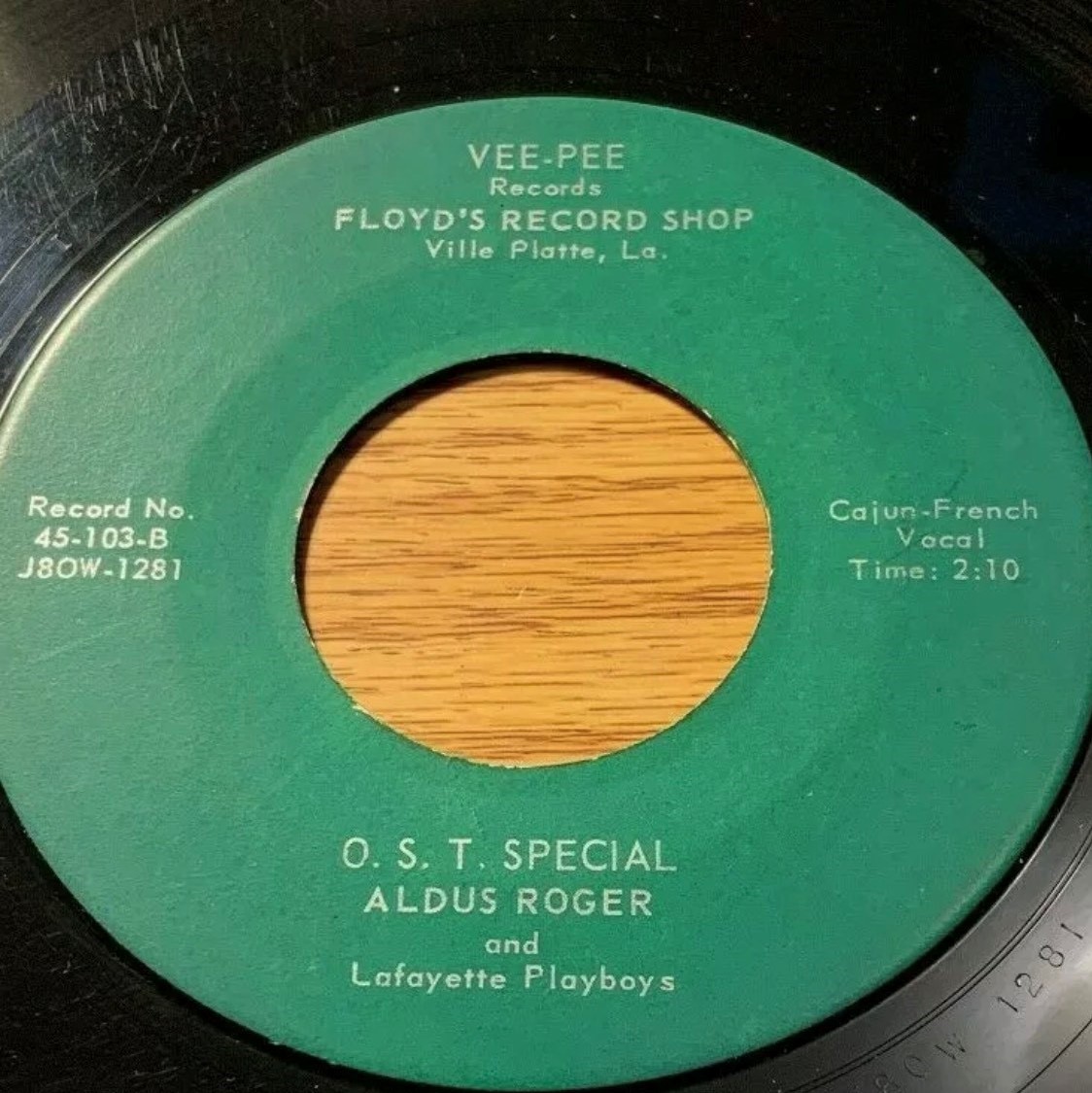
Following Lawrence's example, Aldus went to Floyd to record and put out a record of him and his band. While Floyd didn't have a studio yet, he had to use Miller's studio in Crowley for some of his early releases. It was in 1958 that Aldus recorded "O.S.T Special" at Modern Sound Studio for Vee Pee 103. Floyd had it shipped to Nashville and RCA pressed it with a unique green label.
 Aldus was known for having a tight band and this recording finds the band playing in high gear. Doc Guidry joined the band during this time and this recording marks his first record with Aldus. Phillip Alleman played his first dance when he was 11 with Aldus; replacing his brother, Clarence, on guitar and started a 25 year career with Aldus. Fernest “Man” Abshire joined the band around this time; he played with Aldus until his death. Johnny Credeur played with Aldus from 1958 to 1964, joining Belton Richard's group afterwards. Tunice "T Man" played with Aldus for a couple of years, sadly passing away at age 29.
 O.S.T is in reference to the O.S.T dance hall in Rayne, La. The name is shortened for the Old Spanish Trail, named after a colonial Spanish Highway that connected San Diego, Ca. to St Augustine, Fla. The old route is now mostly made up of Highway 90 that passes thru Crowley and Rayne.
Musician Michael Dupuy says about the record:
 "The unique and odd thing about that record is the fact that no other instrument takes a lead. It is strictly accordion with a strong rhythm guitar that echoes a bass at times. Also, there’s no drums being played. I am pretty sure it’s a cabasa."
Resources:
Broven: South To Louisiana
Early Cajun Music blog
Michael Dupuy
Johnnie Allen- Memories
Picture of Aldus from the Michael Dupuy collection.
Session info:
Acdn with possibly Oran ‘Doc Guidry (fdl), Phillip Alleman (st-g), Johnny Credeur
(g), Tunice Abshire (b-g), Fernest ‘Man’ Abshire (v/d)
Modern Sound Studio, Crowley LA: 1958
VP 103A (J8OW1280) Midway waltz
(La valse a Alida) Vee Pee 103,
Jin 108, Swallow 110
3003, LP6003
Ace(E) CDCHD743
VP 103B (J8OW 1281)O.S.T. (Cajun) special Vee-Pee 103, Jin 108,
Swallow 110, 3003,
LP6001 LP6007,
Ace(E) CDCHD 743


