Showing posts with label Junior Benoit. Show all posts

Thursday, April 1, 2021

Lawrence Walker- "Evangeline Waltz"


George Khoury was a business man from Lake Charles who owned a record shop. He got into releasing records by financing Virgil Bozeman's OT Records. Soon he started his own record label, calling it Khoury's. Operating out of his record shop, he soon was attracting Cajun musicians from East Texas and south Louisiana.


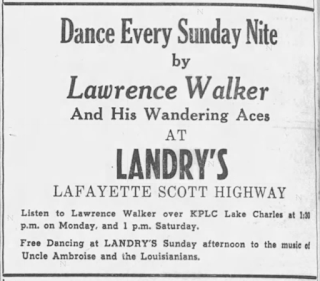
With his new business, he started off with the recordings of Lawrence Walker. Lawrence's popularity was well known around south Louisiana at this time as he was filling up the local dancehalls. Khoury signed Lawrence before Nathan Abshire as he knew Lawrence's intense accordion would rival Nathans's.


So in 1950, Lawrence emerged from retirement and stated recording for George Khoury. That first session produced two records. They sold well enough and the following year; Khoury had him back in the studio. Lawrence did something different than what his competitor Nathan was doing; he added a hypnotic drum beat to his songs. This session produced what would be his biggest seller; "Evangeline Waltz".


J'sus assis dans la port de ma maison, après pleurer,


J'sus après pleurer pour tu t'en reviens à rejoindre ton nègre,

Oui, chère 'tit monde, quand t'as quitter d'la maison,

Tu m'as dit tu pouvais, mais, p'us m'aimer,

Oh, yé yaille, mon cœur me fais mal.  

J'ai p'us personne à la maison, mais, pour m'aimer.


Oui, chère 'tit monde, si tu voudrais t'en revenir,

J'te pardonnerais pour tout ça que tu m'as fait,

C'est d'voir, aujourd'hui, j'ai p'us personne pour m'aimer

J'sus moi, tout seul, après mourir dedans l'chagrin.

Oh, bébé, mon chère 'tit bébé,

J'ai p'us personne à la maison, mais, pour m'aimer.


J'sus assis dans la porte de ma maison, après jongler,

J'sus après jongler si jamais tu va revenir,

Oui, chère 'tit monde, quand t'as quitter d'la maison,

Tu m'as dit tu pouvais, mais, p'us m'aimer.


Lawrence and his band play top notch here, doing a bluesy waltz. His band at the time consisted of U.J. Meaux on fiddle, Demus Comeaux on guitar, Junior Benoit on steel and Lawrence Trehan on drums.


While most pressings started off with a run of 500 copies, its safe to say "Evangeline Waltz" had multiple pressings.  Even when Khoury started focusing on rock and roll and country sides later on, he would reissue his big sellers on the new 45 rpm medium. The only two Cajun artists he reissued on 45 rpm was Nathan Abshire and of course; Lawrence Walker.

Lawrence's sound became the prototype of what Khoury's records were to sound like.  His success on Khoury's  prompted George Khoury to sign Nathan in 1951 and even had him to stick with the formula that Lawrence had created. He would go on to record for the label until 1955. Even then Lawrence would try to keep up with the times, even recording up tempo English songs.


Years later when Chris Strachwitz was compiling a Khoury's recording compilation, George Khoury was insistent on having Lawrence's "Evangeline Waltz" on it saying:


"Make this at once- will pay you for your trouble. Don't let no one have Evangeline Waltz!"


Session info

V/acdn, Ulysse Joseph (U J) Meaux (fdl), Demus Comeaux (g).Valmont ‘Junior’ 

Benoit (st-g), Lawrence Trahan (d)

Lake Charles LA; (possibly Goldband Studio) 1951

A Evangeline waltz Lyric/Khoury’s 615


Resources

Wade Falcon- Early Cajun Music Blog

Liner notes to Cajun Honky Tonk Vol 1 & 2

Wednesday, September 23, 2020

Nathan Abshire- "Lemonade Song"

                                                    
The 1960's were the beginning of a Cajun Cultural renaissance. Interest in more traditional Cajun music emerged after years of Rock, Pop and Country influence and one of the leaders was a accordion pioneer; Nathan Abshire.


Nathan's popularity rose in the late 1940's recording for the Khoury's label. The label slowly faded out of the Cajun music scene and the beginning of the 1960's found him recording for J.D. Miller. While Nathan and his new band made some great recordings on the label; Nathan wasn't happy with Miller's antics.

By 1963, he wanted out. Floyd Soileau had started up a label and was having success releasing traditional Cajun music. Nathan approached Floyd about recording for Swallow Records in the mid 1960's. Sadly, Nathan was still under contract with Miller at this time. Nathan ended up hiring a lawyer to get out of contract with Miller to record with Floyd.

Floyd Soileau recalls:

“I went to see him when he was working at the Basile dump, People were starting to cover ‘Pine Grove Blues’ and I researched the song at BMI but couldn’t find it. Khoury never registered the song but Nathan had recorded it as ‘Pinegrove Blues’ for J.D. Miller. He registered it at BMI, but wasn’t paying Nathan royalties. I told Nathan that if he signed a publishing contract with me, I could get him his writer’s royalties. I took him to a notary and he put his X on a contract. I cleared the song with BMI. J. D. contested it, but I had a contract. J.D. claimed his got burned in fire. But Dewey Balfa, who played on the Miller sessions, said nobody signed anything with J. D.”

So in the 1965, Nathan gave recording another try. He assembled a band who had recorded with him earlier in the decade. Dewey Balfa had recorded before as a Pine Grove Boy and had a good working relationship and friendship with Nathan. Their musical careers would continue till Nathan's death. Junior Benoit and Thomas Langley were also mainstays in Nathan's band at this point.

In 1966 they entered Floyd's and recorded a number of sides at the Swallow studio in Ville Platte. Nathan knew he needed to cut some 45's to help with local bookings, so at this session; Nathan and the Pine Grove Boys reworked a song Columbus Fruge had recorded in 1929 as "Point Clear Blues". 

Moi j'aime cousin et moi j'aime cousine mais j'aime mieux la cuisinière.  
Samedi, ce soir, moi courir au bal, je m'ai saoulé comme un gros cochon. 
Dimanche matin, il est tout manière malade,
Passez lui le verre à limonade.

L'hiver arrive, l'hiver arrive, ton p'tit nég a pas de couverte,
Samedi, ce soir, l'ai courir au bal, je m'ai saoulé comme un gros cochon,
Dimanche matin, j'ai tout manière malade, 
Passez moi le verre à limonade.

Moi j'aime cousin et moi j'aime cousine mais j'aime mieux la cuisinière.  
Samedi, ce soir, moi courir au bal, moi saoulé comme un gros cochon. 
Dimanche matin, il est tout manière malade,
Passez moi le verre à limonade.

Nathan had paid tribute to earlier pre war Cajun songs before. He had transformed the Segura  Brothers "Mosquito Ate My Sweetheart" into "La Valse De Holly Beach"and turned "Fe Fe Ponchaux" into the "Musical Five Special". Previously, Leroy Broussard had recorded a version of the "Lemonade Song" in 1957 for Goldband, but it seems Nathan's version is the most well known version and rightfully so.

From 1965 to 1972 Nathan recorded for Swallow Records with great success and it seems these recordings are what he's best remembered for. Nathan hit his stride as a recording artist in these years, turning out a string of remarkable records for the Swallow label.

Floyd Soileau remembers:

“That was when I had my first little studio. “We did some things with the Balfas and some with other musicians Nathan rounded up.  If you sold 1,500 copies of a Cajun single, then you jumped up and shouted ‘Hooray.’ Most of Nathan’s singles did 1,500 to 2,000, with a lot being sold to juke box operators."

With this new success, Nathan appeared with Dewey Balfa and The Balfa Brothers at the Newport Folk Festival in 1967. Along with Dewey , Nathan devoted much of his time in the 1960's and 70's to promoting Cajun music through appearances at festivals, colleges, and schools throughout the United States. Nathan stayed with Swallow until the mid-1970's when Soileau slowed down his recording activities.


AND HIS PINE GROVE BOYS (10170, 10173 & 10175)
V-1/acdn, Dewey Balfa, Dewey Balfa and Will Balfa (fdl), Darius LeBlanc, Junior
Benoit (g), Thomas Langley (d)
Swallow Studio, Ville Platte LA: 1966


Resources
Picturing the Cajun Revival: Swallow Records, Album Art, and Marketing
Early Cajun Music Blog
https://64parishes.org/entry/dewey-balfa

Sunday, July 12, 2020

Nathan Abshire and the Pine Grove Boys- Popcorn Blues

By 1958, the recording career of Nathan Abshire and the Pine Grove Boys recording career with Khoury's was coming to a end. The last three of their records on Khoury's would be that of a new band that Nathan would use until the band called it quits. The market for Cajun music was moving from the big nightclubs that were operating seven nights a week to just having weekend dances. Clubs that didn't have space or money for bands could have a good jukebox full of the latest Cajun records.

At this time, Floyd Soileau was recording and releasing Cajun music. J.D. Miller had put a hold on releasing Cajun music on his label in favor of recording country and blues. Floyd not having his own studio at the time, saw the opportunity and used Miller's studio to his advantage to record his artists. It didn't take Miller long to figure out he needed to be back in the Cajun music market.

Knowing Nathan Abshire could still sell records, Miller quickly signed him to a contract. Soon he had Nathan and the Pine Grove Boys in the studio. Miller knew how to make quality recordings at this point and had the best studio to do just that. In fact some of the best recordings of Nathan and the Pine Grove Boys come from this period. This was a change for Nathan in the sense that most of the recordings he did for Khoury's were recorded in radio stations. Miller's studio in Crowley would mark the first time Nathan had been in a real studio.

Nathan's first release for Miller was in 1959 on the Cajun Classics label. The following year, Nathan kick started off Miller's new 45 label, Kajun Records. Kajun 500 was "Popcorn Blues" backed by "Broken Hearted Blues" and as far as one to kick off the label; it's hard to beat. Junior Benoit's guitar kicks off the song followed by Nathan's accordion. While other Cajun musicians had been experimenting with incorporating the new rock and roll sound into their music, this is Nathan's first attempt at it. Also on board with the new band was Robert Bertrand who has a great fiddle solo on "Popcorn Blues", while Ed Juneau handles the vocals with Nathan. The call and response vocals they use on the track are similar to the vocal recordings of "Pine Grove Blues".

J'ai étais au bal hier au soir. (Ici dans la village?)
J'ai étais au bal hier au soir. (Ah, mon vieux cochon!)
On a mangé du tac-tac!
On a mangé du tac-tac. (Vous-autres a pas emporté un tit brin, vieux nègre?)
C'est des pacanes à Nonc Edouard qu'il est si bon en pralines.
Je m'ai saoulé hier au soir. (j'croyais t'avait dit t'avais arreter d'boire, mon vieux nègre!)
Je m'ai saoulé hier au soir. (C'est ça qui amener dans l'finir!)
On a mangé des grillots!
On a mangé des grillots.
Je m'ai saoulé hier au soir.
Je vas me saouler à soir encore. Ah ouais!
J'ai été au bal hier au soir. (Toi tout seul, Nathan?)
J'ai été au bal hier au soir. (Pense t'amené ta gamine avec toi, hein?)
On a mangé des grillots. (Comment t'as fait ça mon nègre? T'as pas d'dents!)
On a mangé des grillots. (Ta vielle t'as oté un tit brin, hein?)
C'est des pacanes à Nonc Edouard qu'etait si bon en pralines.
Je m'ai saoulé hier au soir. (Ah, tu devrait arreter d'boir, mon nègre!)

Je m'ai saoulé hier au soir.

Sadly, Nathan was never happy after signing a contract with Miller. Nathan and his new drummer and vocalist, Thomas Langley, were against any interference from Miller when they recorded. It has been noted by another recording artist for Miller, Kate Webster, that Miller was a strong personality and ruled the studio. Nathan and Langley tried standing up to him to keep the Cajun music pure, but Miller had other ideas that he would have the band try. 

While there was plenty of drama surrounding these Miller recordings, some of the Pine Grove Boys best recordings were done at the studios in Crowley. At this point Miller knew his way around a recording studio, the proper microphone set up and how to set the recording levels. His expertise in the studio would show on these Kajun releases from in 1959 to 1964.

It all came to a head and soon Nathan was at Floyd Soileau's trying to record. Floyd told Nathan thee was nothing he could do and that Miller had a iron clad contract with him. Nathan and his band were frustrated and Nathan didn't record for two years. Nathan ended up having to get his own lawyer and after negotiations, he was finally free to record elsewhere.


Resources
Early Cajun Music blog
Ron Yule-Cajun Dancehall Heyday
Bryan L - lyrics

Release Info:

KR 200 Popcorn Blues ] Kajun 500
KR 201 Broken Hearted Blues ] Kajun 500